Brand's compounding advantage doesn't require the scale of the compounders. The opposite, in fact.
Brand is having a moment. Every marketing conference in 2026 has three panels on it. The CMO discourse has rediscovered coherence, distinctiveness, and long-run brand-building the way medicine rediscovered handwashing, several decades late and with real enthusiasm.
This is good. It's also where a specific trap opens up.
The trap is that most of the case studies used to prove the point are companies whose brands were built when brand-building was easier, cheaper, and less crowded. Coke. Nike. Apple. IBM. LEGO. Ferrari. The photographs on the slides are always the same. A wordmark refined over a century. A colour owned so completely it's been trademarked. An icon so familiar it doesn't need the name attached.
Worth noting: none of these are dormant advantages. Coke isn't coasting on 1886 goodwill. It just rebuilt its entire visual system to hold coherence across every place a customer now meets the brand. Head start matters. The ongoing investment matters more. What looks like accumulated advantage is also active defence, and the incumbents know it.
The founder of a five-person business, or the CMO of a five-hundred-person one, sitting in that audience sees the slides and thinks, reasonably, "I can't do that." Because they can't. Not this year. Not with their budget. Not against those incumbents. The gap between the challenger brand and the compounded brand is so vast that the natural response is to conclude that brand, whatever else it might be, is a game for people who already won it.
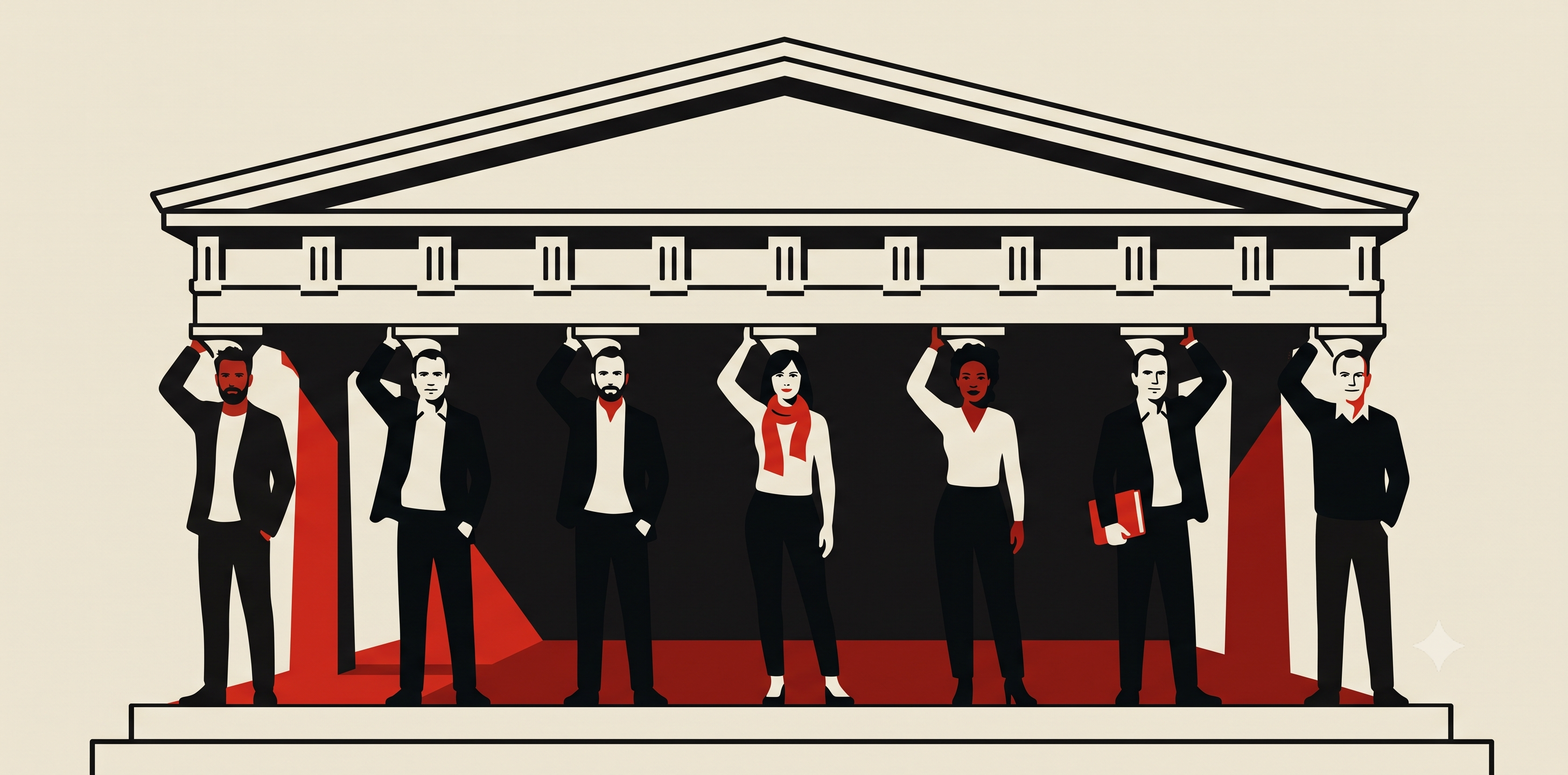
This is the wrong lesson, and the Signalworks strategist Eaon Pritchard put the correct one better than I could. "You don't need to build a Parthenon as a first step in fomenting a democracy. Religions don't start with a Cathedral."
What we're actually looking at
Humans have a cognitive habit that gets us into trouble here. Nassim Taleb calls it the narrative fallacy: the retrospective construction of coherent stories that make past events seem inevitable and past decisions seem necessary. We look at the end state of a good idea, see how imposing it is, and assume the whole path was engineered rather than accreted. The Parthenon becomes the argument for Athenian democracy. The cathedral proves the religion. The billion-dollar brand justifies the founder's early conviction.
None of this is how any of it happened.
Athens was mostly small buildings and a lot of talk. The arguments in the agora were about tax debts, tribal power, and the misconduct of specific archons, not about the high ideals of self-government those arguments eventually produced. The ideals got attached later, in the retelling. Early Christianity was thirty-odd people meeting in houses. Coca-Cola was one pharmacist, one syrup, and a slightly desperate marketing budget in 1886. Nike was two men and a waffle iron. Aldus Manutius was a Latin tutor in his forties who'd never worked a printing press when he decided he was going to fix European publishing.
Each of these things looks, from where we stand, like an inevitability. They were nothing of the kind. They were a sequence of small, consistent decisions, most of them made under conditions of genuine uncertainty, that compounded because the people making them held their nerve on the small stuff. The cathedral came later, sometimes centuries later, and only because the small stuff had already worked.
The compounding argument, again
Brand's most useful property is that it compounds. This isn't a novel claim. I've written it up before, at the level of general principle. What's worth adding is the corollary.
If brand compounds, then the important thing on day one isn't the size of the effort. It's whether you're building memory structures at all, and whether they're consistent enough to reinforce each other rather than cancel out. Memory structures are fragile. A mark, a repeated phrase, a specific point of view: these become recognisable only when the buyer encounters them often enough, in the same form, that they hold their shape in the mind. Every coherent repetition strengthens them. Every incoherent variation chips at them.
A challenger brand acting coherently, week after week, for five years, has at the end of five years a mental asset in the audience's head that no competitor can buy back. A larger brand acting incoherently over the same period has spent the money to produce the work and produced nothing durable in the buyer at all.
This is good news for challenger brands at any scale. The compounding advantage doesn't require the scale of the compounders. It requires the discipline of the compounders, which is a different resource entirely, and one that's accessible to anyone willing to make a decision about who they are and hold it.
There's a wrinkle worth naming. Coherence is harder now than it's ever been, because the surfaces on which a brand appears have multiplied to a scale no brand playbook was designed to handle. Every LinkedIn post, every automated email, every customer service reply, every AI-generated summary is a brand surface, and the cost of creating another one has fallen to zero. The total surface area a brand has to hold coherent, weekly, has never been larger, and the arithmetic works against you as the business grows. Which, awkwardly for the incumbents, tilts the compounding advantage toward every challenger whose scale is still small enough to hold coherent. Their coherence tax is low. The big brand is being incoherent, at scale, across more surfaces than any hierarchy can inspect. And the buyer sees the incoherence before the org chart does.
What accessibility actually looks like
If you're running a business of five people or five hundred, and you want to start compounding, the answer isn't a rebrand. It isn't an agency retainer. It isn't a Parthenon. It's four decisions.
Decide what you say and, more importantly, what you won't. This is the single biggest determinant of whether anyone will remember you in a year, and it doesn't cost anything except the discomfort of ruling things out.
Decide how you sound. A voice specific enough that a writer or a model could produce something in it. A page. Twelve lines. Enough to be a reference for everyone you work with, forever.
Decide what your mark is. Not necessarily a logo. A visual and verbal signature you commit to using, unchanged, on every surface a buyer might encounter you on.
Decide who owns it. Nobody enforces coherence by accident. If it's not a named person's job to keep the mark and the voice and the position aligned, they'll drift, quickly, at a rate proportional to how many people you eventually hire.
That's the whole starter kit. It costs less than any consultant will quote you, because the substance is decision, not production, and decisions are free once you're willing to make them.
The out-cohere move, twice
If you can't outspend Coca-Cola, and you can't, you can still out-cohere it. Coke is enormous, distributed, and old. Those are advantages. Coke is also a hundred and forty years of layered brand equity being managed by a rotating cast of custodians whose main job is to not break it. Coke, structurally, isn't a nimble brand. It can't say something new tomorrow that repositions the whole business by Friday. You can.
The same logic applies to whole industries, not just brands. I joined Fortescue Future Industries to build the brand globally, and ended up as global head of brand and digital, bringing the innovation arm and the mining business under one coherent voice across ninety countries. The energy and technology sectors are dominated by incumbents who spend more on communications and lobbying in a quarter than most companies spend in a decade. Trying to outspend fossil fuels on message dominance isn't a strategy. It's a fantasy. The work instead was to make consistent decisions every day, across every surface and every market, so that a first-time encounter with the brand in Santiago or Oslo or the Pilbara said the same thing about who we were and what we believed. That's how a big green circle became a commercial argument for real action on climate. Not through amplification of the already-convinced, but through decisions, taken daily, that let new audiences meet a coherent version of us on first contact.
Teams working inside a brand often see their biggest challenge as differentiating their work from the mass of other activity happening around them in the business. The instinct is to separate what they ship from the way the brand looks everywhere else. Make it stand out from the stuff they see in the corridor every day. That instinct is fine on internal surfaces, where the audience is a colleague and the stakes are attention. On external surfaces, it's expensive. Every deviation sacrifices the head start a coherent brand offers, and fractionally undermines the whole-of-brand effect the business relies on to stand out from everything else happening in the world.
Everything the incumbents are protecting is, from a challenger brand's point of view, dead weight. You're the one who gets to make the interesting decisions. The trade is that the individual decisions matter more, because you have fewer surfaces on which to be inconsistent and fewer years of compounded goodwill to fall back on. It also means every touchpoint matters more, because the brand has to introduce itself, correctly, on every first encounter. Coherence is what makes new audiences reachable at all. Fragmentation is what makes them expensive.
That's not a disadvantage. That's an assignment.
Close
Brand is having a moment because the market has finally noticed what a certain kind of practitioner has been saying for a decade: in an era of infinite production, coherence is what still compounds. The moment will, hopefully, last. Marketers are oft seduced by the next shiny thing, and coherence is quieter and slower than most. The winners of it won't be the biggest brands. They'll be the ones who understood, early, that the compounding was accessible to anyone willing to make a small number of consistent decisions and hold them.
You don't need a Parthenon. You need the first coherent decision, and then the second, and then the discipline to keep making them.
Religions start with conversations, not cathedrals. A claim, held long enough, transmutes into belief.
Plan B helps businesses make the decisions that compound. Five people or ninety countries, the discipline is the same. If you're starting yours, or restarting, we'd love to help. Get in touch.
You dont need the parthenon · MD
You Don't Need a Parthenon
Brand's compounding advantage doesn't require the scale of the compounders. The opposite, in fact.
Brand is having a moment. Every marketing conference in 2026 has three panels on it. The CMO discourse has rediscovered coherence, distinctiveness, and long-run brand-building the way medicine rediscovered handwashing, several decades late and with real enthusiasm.
This is good. It's also where a specific trap opens up.
The trap is that most of the case studies used to prove the point are companies whose brands were built when brand-building was easier, cheaper, and less crowded. Coke. Nike. Apple. IBM. LEGO. Ferrari. The photographs on the slides are always the same. A wordmark refined over a century. A colour owned so completely it's been trademarked. An icon so familiar it doesn't need the name attached.
Worth noting: none of these are dormant advantages. Coke isn't coasting on 1886 goodwill. It just rebuilt its entire visual system to hold coherence across every place a customer now meets the brand. Head start matters. The ongoing investment matters more. What looks like accumulated advantage is also active defence, and the incumbents know it.
The founder of a five-person business, or the CMO of a five-hundred-person one, sitting in that audience sees the slides and thinks, reasonably, "I can't do that." Because they can't. Not this year. Not with their budget. Not against those incumbents. The gap between the challenger brand and the compounded brand is so vast that the natural response is to conclude that brand, whatever else it might be, is a game for people who already won it.
This is the wrong lesson, and the Signalworks strategist Eaon Pritchard put the correct one better than I could. "You don't need to build a Parthenon as a first step in fomenting a democracy. Religions don't start with a Cathedral."
What we're actually looking at
Humans have a cognitive habit that gets us into trouble here. Nassim Taleb calls it the narrative fallacy: the retrospective construction of coherent stories that make past events seem inevitable and past decisions seem necessary. We look at the end state of a good idea, see how imposing it is, and assume the whole path was engineered rather than accreted. The Parthenon becomes the argument for Athenian democracy. The cathedral proves the religion. The billion-dollar brand justifies the founder's early conviction.
None of this is how any of it happened.
Athens was mostly small buildings and a lot of talk. The arguments in the agora were about tax debts, tribal power, and the misconduct of specific archons, not about the high ideals of self-government those arguments eventually produced. The ideals got attached later, in the retelling. Early Christianity was thirty-odd people meeting in houses. Coca-Cola was one pharmacist, one syrup, and a slightly desperate marketing budget in 1886. Nike was two men and a waffle iron. Aldus Manutius was a Latin tutor in his forties who'd never worked a printing press when he decided he was going to fix European publishing.
Each of these things looks, from where we stand, like an inevitability. They were nothing of the kind. They were a sequence of small, consistent decisions, most of them made under conditions of genuine uncertainty, that compounded because the people making them held their nerve on the small stuff. The cathedral came later, sometimes centuries later, and only because the small stuff had already worked.
The compounding argument, again
Brand's most useful property is that it compounds. This isn't a novel claim. I've written it up before, at the level of general principle. What's worth adding is the corollary.
If brand compounds, then the important thing on day one isn't the size of the effort. It's whether you're building memory structures at all, and whether they're consistent enough to reinforce each other rather than cancel out. Memory structures are fragile. A mark, a repeated phrase, a specific point of view: these become recognisable only when the buyer encounters them often enough, in the same form, that they hold their shape in the mind. Every coherent repetition strengthens them. Every incoherent variation chips at them.
A challenger brand acting coherently, week after week, for five years, has at the end of five years a mental asset in the audience's head that no competitor can buy back. A larger brand acting incoherently over the same period has spent the money to produce the work and produced nothing durable in the buyer at all.
This is good news for challenger brands at any scale. The compounding advantage doesn't require the scale of the compounders. It requires the discipline of the compounders, which is a different resource entirely, and one that's accessible to anyone willing to make a decision about who they are and hold it.
There's a wrinkle worth naming. Coherence is harder now than it's ever been, because the surfaces on which a brand appears have multiplied to a scale no brand playbook was designed to handle. Every LinkedIn post, every automated email, every customer service reply, every AI-generated summary is a brand surface, and the cost of creating another one has fallen to zero. The total surface area a brand has to hold coherent, weekly, has never been larger, and the arithmetic works against you as the business grows. Which, awkwardly for the incumbents, tilts the compounding advantage toward every challenger whose scale is still small enough to hold coherent. Their coherence tax is low. The big brand is being incoherent, at scale, across more surfaces than any hierarchy can inspect. And the buyer sees the incoherence before the org chart does.
What accessibility actually looks like
If you're running a business of five people or five hundred, and you want to start compounding, the answer isn't a rebrand. It isn't an agency retainer. It isn't a Parthenon. It's four decisions.
Decide what you say and, more importantly, what you won't. This is the single biggest determinant of whether anyone will remember you in a year, and it doesn't cost anything except the discomfort of ruling things out.
Decide how you sound. A voice specific enough that a writer or a model could produce something in it. A page. Twelve lines. Enough to be a reference for everyone you work with, forever.
Decide what your mark is. Not necessarily a logo. A visual and verbal signature you commit to using, unchanged, on every surface a buyer might encounter you on.
Decide who owns it. Nobody enforces coherence by accident. If it's not a named person's job to keep the mark and the voice and the position aligned, they'll drift, quickly, at a rate proportional to how many people you eventually hire.
That's the whole starter kit. It costs less than any consultant will quote you, because the substance is decision, not production, and decisions are free once you're willing to make them.
The out-cohere move, twice
If you can't outspend Coca-Cola, and you can't, you can still out-cohere it. Coke is enormous, distributed, and old. Those are advantages. Coke is also a hundred and forty years of layered brand equity being managed by a rotating cast of custodians whose main job is to not break it. Coke, structurally, isn't a nimble brand. It can't say something new tomorrow that repositions the whole business by Friday. You can.
The same logic applies to whole industries, not just brands. I joined Fortescue Future Industries to build the brand globally, and ended up as global head of brand and digital, bringing the innovation arm and the mining business under one coherent voice across ninety countries. The energy and technology sectors are dominated by incumbents who spend more on communications and lobbying in a quarter than most companies spend in a decade. Trying to outspend fossil fuels on message dominance isn't a strategy. It's a fantasy. The work instead was to make consistent decisions every day, across every surface and every market, so that a first-time encounter with the brand in Santiago or Oslo or the Pilbara said the same thing about who we were and what we believed. That's how a big green circle became a commercial argument for real action on climate. Not through amplification of the already-convinced, but through decisions, taken daily, that let new audiences meet a coherent version of us on first contact.
Teams working inside a brand often see their biggest challenge as differentiating their work from the mass of other activity happening around them in the business. The instinct is to separate what they ship from the way the brand looks everywhere else. Make it stand out from the stuff they see in the corridor every day. That instinct is fine on internal surfaces, where the audience is a colleague and the stakes are attention. On external surfaces, it's expensive. Every deviation sacrifices the head start a coherent brand offers, and fractionally undermines the whole-of-brand effect the business relies on to stand out from everything else happening in the world.
Everything the incumbents are protecting is, from a challenger brand's point of view, dead weight. You're the one who gets to make the interesting decisions. The trade is that the individual decisions matter more, because you have fewer surfaces on which to be inconsistent and fewer years of compounded goodwill to fall back on. It also means every touchpoint matters more, because the brand has to introduce itself, correctly, on every first encounter. Coherence is what makes new audiences reachable at all. Fragmentation is what makes them expensive.
That's not a disadvantage. That's an assignment.
Close
Brand is having a moment because the market has finally noticed what a certain kind of practitioner has been saying for a decade: in an era of infinite production, coherence is what still compounds. The moment will, hopefully, last. Marketers are oft seduced by the next shiny thing, and coherence is quieter and slower than most. The winners of it won't be the biggest brands. They'll be the ones who understood, early, that the compounding was accessible to anyone willing to make a small number of consistent decisions and hold them.
You don't need a Parthenon. You need the first coherent decision, and then the second, and then the discipline to keep making them.
Religions start with conversations, not cathedrals. A claim, held long enough, transmutes into belief.
Plan B helps businesses make the decisions that compound. Five people or ninety countries, the discipline is the same. If you're starting yours, or restarting, we'd love to help. Get in touch.
You dont need the parthenon · MD
You Don't Need a Parthenon
Brand's compounding advantage doesn't require the scale of the compounders. The opposite, in fact.
Brand is having a moment. Every marketing conference in 2026 has three panels on it. The CMO discourse has rediscovered coherence, distinctiveness, and long-run brand-building the way medicine rediscovered handwashing, several decades late and with real enthusiasm.
This is good. It's also where a specific trap opens up.
The trap is that most of the case studies used to prove the point are companies whose brands were built when brand-building was easier, cheaper, and less crowded. Coke. Nike. Apple. IBM. LEGO. Ferrari. The photographs on the slides are always the same. A wordmark refined over a century. A colour owned so completely it's been trademarked. An icon so familiar it doesn't need the name attached.
Worth noting: none of these are dormant advantages. Coke isn't coasting on 1886 goodwill. It just rebuilt its entire visual system to hold coherence across every place a customer now meets the brand. Head start matters. The ongoing investment matters more. What looks like accumulated advantage is also active defence, and the incumbents know it.
The founder of a five-person business, or the CMO of a five-hundred-person one, sitting in that audience sees the slides and thinks, reasonably, "I can't do that." Because they can't. Not this year. Not with their budget. Not against those incumbents. The gap between the challenger brand and the compounded brand is so vast that the natural response is to conclude that brand, whatever else it might be, is a game for people who already won it.
This is the wrong lesson, and the Signalworks strategist Eaon Pritchard put the correct one better than I could. "You don't need to build a Parthenon as a first step in fomenting a democracy. Religions don't start with a Cathedral."
What we're actually looking at
Humans have a cognitive habit that gets us into trouble here. Nassim Taleb calls it the narrative fallacy: the retrospective construction of coherent stories that make past events seem inevitable and past decisions seem necessary. We look at the end state of a good idea, see how imposing it is, and assume the whole path was engineered rather than accreted. The Parthenon becomes the argument for Athenian democracy. The cathedral proves the religion. The billion-dollar brand justifies the founder's early conviction.
None of this is how any of it happened.
Athens was mostly small buildings and a lot of talk. The arguments in the agora were about tax debts, tribal power, and the misconduct of specific archons, not about the high ideals of self-government those arguments eventually produced. The ideals got attached later, in the retelling. Early Christianity was thirty-odd people meeting in houses. Coca-Cola was one pharmacist, one syrup, and a slightly desperate marketing budget in 1886. Nike was two men and a waffle iron. Aldus Manutius was a Latin tutor in his forties who'd never worked a printing press when he decided he was going to fix European publishing.
Each of these things looks, from where we stand, like an inevitability. They were nothing of the kind. They were a sequence of small, consistent decisions, most of them made under conditions of genuine uncertainty, that compounded because the people making them held their nerve on the small stuff. The cathedral came later, sometimes centuries later, and only because the small stuff had already worked.
The compounding argument, again
Brand's most useful property is that it compounds. This isn't a novel claim. I've written it up before, at the level of general principle. What's worth adding is the corollary.
If brand compounds, then the important thing on day one isn't the size of the effort. It's whether you're building memory structures at all, and whether they're consistent enough to reinforce each other rather than cancel out. Memory structures are fragile. A mark, a repeated phrase, a specific point of view: these become recognisable only when the buyer encounters them often enough, in the same form, that they hold their shape in the mind. Every coherent repetition strengthens them. Every incoherent variation chips at them.
A challenger brand acting coherently, week after week, for five years, has at the end of five years a mental asset in the audience's head that no competitor can buy back. A larger brand acting incoherently over the same period has spent the money to produce the work and produced nothing durable in the buyer at all.
This is good news for challenger brands at any scale. The compounding advantage doesn't require the scale of the compounders. It requires the discipline of the compounders, which is a different resource entirely, and one that's accessible to anyone willing to make a decision about who they are and hold it.
There's a wrinkle worth naming. Coherence is harder now than it's ever been, because the surfaces on which a brand appears have multiplied to a scale no brand playbook was designed to handle. Every LinkedIn post, every automated email, every customer service reply, every AI-generated summary is a brand surface, and the cost of creating another one has fallen to zero. The total surface area a brand has to hold coherent, weekly, has never been larger, and the arithmetic works against you as the business grows. Which, awkwardly for the incumbents, tilts the compounding advantage toward every challenger whose scale is still small enough to hold coherent. Their coherence tax is low. The big brand is being incoherent, at scale, across more surfaces than any hierarchy can inspect. And the buyer sees the incoherence before the org chart does.
What accessibility actually looks like
If you're running a business of five people or five hundred, and you want to start compounding, the answer isn't a rebrand. It isn't an agency retainer. It isn't a Parthenon. It's four decisions.
Decide what you say and, more importantly, what you won't. This is the single biggest determinant of whether anyone will remember you in a year, and it doesn't cost anything except the discomfort of ruling things out.
Decide how you sound. A voice specific enough that a writer or a model could produce something in it. A page. Twelve lines. Enough to be a reference for everyone you work with, forever.
Decide what your mark is. Not necessarily a logo. A visual and verbal signature you commit to using, unchanged, on every surface a buyer might encounter you on.
Decide who owns it. Nobody enforces coherence by accident. If it's not a named person's job to keep the mark and the voice and the position aligned, they'll drift, quickly, at a rate proportional to how many people you eventually hire.
That's the whole starter kit. It costs less than any consultant will quote you, because the substance is decision, not production, and decisions are free once you're willing to make them.
The out-cohere move, twice
If you can't outspend Coca-Cola, and you can't, you can still out-cohere it. Coke is enormous, distributed, and old. Those are advantages. Coke is also a hundred and forty years of layered brand equity being managed by a rotating cast of custodians whose main job is to not break it. Coke, structurally, isn't a nimble brand. It can't say something new tomorrow that repositions the whole business by Friday. You can.
The same logic applies to whole industries, not just brands. I joined Fortescue Future Industries to build the brand globally, and ended up as global head of brand and digital, bringing the innovation arm and the mining business under one coherent voice across ninety countries. The energy and technology sectors are dominated by incumbents who spend more on communications and lobbying in a quarter than most companies spend in a decade. Trying to outspend fossil fuels on message dominance isn't a strategy. It's a fantasy. The work instead was to make consistent decisions every day, across every surface and every market, so that a first-time encounter with the brand in Santiago or Oslo or the Pilbara said the same thing about who we were and what we believed. That's how a big green circle became a commercial argument for real action on climate. Not through amplification of the already-convinced, but through decisions, taken daily, that let new audiences meet a coherent version of us on first contact.
Teams working inside a brand often see their biggest challenge as differentiating their work from the mass of other activity happening around them in the business. The instinct is to separate what they ship from the way the brand looks everywhere else. Make it stand out from the stuff they see in the corridor every day. That instinct is fine on internal surfaces, where the audience is a colleague and the stakes are attention. On external surfaces, it's expensive. Every deviation sacrifices the head start a coherent brand offers, and fractionally undermines the whole-of-brand effect the business relies on to stand out from everything else happening in the world.
Everything the incumbents are protecting is, from a challenger brand's point of view, dead weight. You're the one who gets to make the interesting decisions. The trade is that the individual decisions matter more, because you have fewer surfaces on which to be inconsistent and fewer years of compounded goodwill to fall back on. It also means every touchpoint matters more, because the brand has to introduce itself, correctly, on every first encounter. Coherence is what makes new audiences reachable at all. Fragmentation is what makes them expensive.
That's not a disadvantage. That's an assignment.
Close
Brand is having a moment because the market has finally noticed what a certain kind of practitioner has been saying for a decade: in an era of infinite production, coherence is what still compounds. The moment will, hopefully, last. Marketers are oft seduced by the next shiny thing, and coherence is quieter and slower than most. The winners of it won't be the biggest brands. They'll be the ones who understood, early, that the compounding was accessible to anyone willing to make a small number of consistent decisions and hold them.
You don't need a Parthenon. You need the first coherent decision, and then the second, and then the discipline to keep making them.
Religions start with conversations, not cathedrals. A claim, held long enough, transmutes into belief.
Plan B helps businesses make the decisions that compound. Five people or ninety countries, the discipline is the same. If you're starting yours, or restarting, we'd love to help. Get in touch.