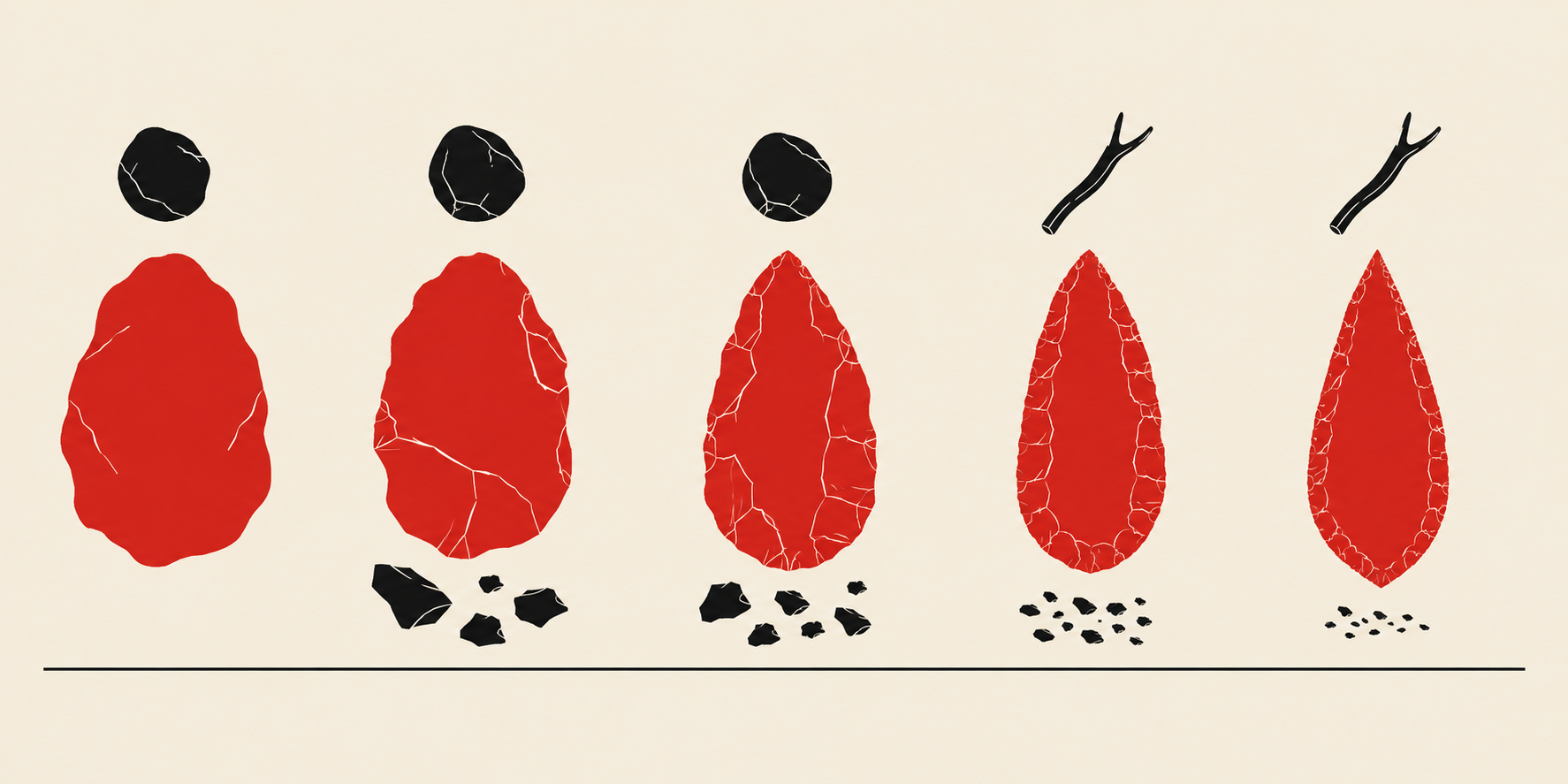
Write me a short essay on XXXX.
Paste that into any frontier model, swap the XXXX for a topic, and wait about eight seconds. It will hand you back a plausible-sounding argument built from an average of everything ever written on the subject. The prose will be competent. The structure will hold. The references, mostly, will be real. It will be, on inspection, both fluent and forgettable.
This is the new ground floor. Everyone walking gets to this point. Industry titans have spent two years congratulating themselves in public for reaching it.
The question isn't what the machines can do. It's what they can't. The honest answer is that they still can't choose. Not in the way a human writer chooses.
A model retrieves. A model recombines. Given a corpus (a warehouse full of books,) it will find the next most likely token and place it after the last. It's very good at this, and getting better. What it isn't doing is choosing what matters.
Writing is choosing. You walk through a life accumulating context. Parts are deliberate: a book you sought out and passed on, a city you moved to because it felt important. Most are threads of fate: the train delay that put you in the wrong carriage next to the person who taught you a thing they didn't know they were teaching, the chapter of a book you skimmed at seventeen that surfaces at forty-three, exactly when you need it.
Out of that unstructured pile, you choose. You notice one thing rather than another. You pull a thread from a memory nobody else has. You put two ideas next to each other that have never been in a room together before. And then you sew.
That is what a writer does. Curation before composition. Consideration before writing. The story is the artefact left behind when a mind chooses what to notice from the context it has been shaped by.
Machines don't have this problem. They have the whole corpus, all at once, weighted by statistical presence. The novel choices a good writer makes by chance and taste are, for a model, unreachable, because the model is optimising for the most probable next word, not the most surprising or the most true. The surprising and the true are lower-probability than the average. That's why they land.
Which means the machines have upended the retrieval and recombination end of writing. They haven't touched the curation end, and they aren't structurally set up to.
If you write for a living, or think for one, this is the part of your job that survives. Not the fluent prose. Not the well-formed argument. The choosing. The taste (many are calling it that). The specific attention you paid to specific things that no one else was paying attention to at the time. The willingness to notice one detail among ten thousand and argue it forward against the average.
The community you learned inside is still talking through you. Your task is to decide what it says next. That decision is the whole of your contribution and, as far as anyone can show, the whole of what still costs a machine more than it's worth.
The lobby is overrun. We need to climb some stairs.
Part three of a short series on inherited ideas. Piece one on the biface here. Piece two on the tool that reads your writing here. Plan B helps businesses turn taste into structure. Get in touch.
--- # You Are More Inherited Than You Think - URL: https://planb.works/writing/you-are-more-inherited-than-you-think - Published: 2026-08-31 - Excerpt: The thing that makes us human is as much carrying stories as it is creating them. Part two of a short series on inherited ideas.Following on from the biface, which we passed forward for 1.7 million years without writing it down, an experiment.
The exceptional Abi Awomosu has built a tool that examines any piece of writing for traces of inheritance. It reads what you've written and shows you where your language comes from. Which idioms are borrowed. Which cadences you learned from someone else. Which framings you've absorbed so completely that they no longer feel borrowed at all.
Paste in something you're proud of. Not something you dashed off. Something you laboured over. A pitch. A speech. A blog post you've been sitting on. Anything you'd call distinctively yours.
Take a spin through the results.
My guess is that you'll see old friends and long internalised memories all through your writing. The teacher who first made you love a particular sentence rhythm. The book you read three times in a year at seventeen. The colleague whose emails you unconsciously started to mimic. The city you grew up in. The country you visited that changed the way you thought about work. All of it distilled into the sentences you now think of as yours.
We are each our own uniquely configured context. But we share a lot with the people we learned with, the place we grew up in, and the places we've travelled. Some of that is choice. Much of it is accident of birth.
The thing that makes us human is as much carrying stories as it is creating them.
If everything you produce carries traces of everyone who taught you, then the people who taught you are still in the world. Their sentences show up in your writing. Their patterns still run through you. The community you learned inside is still talking through you.
Ethnogenesis is real. Voices really do get born. But mostly, voices get carried.
Part two of a short series on inherited ideas. Piece one on the biface here. Piece three, on what the curator does when everyone else is retrieving, is out in a few days. Plan B builds brands that survive being carried. Get in touch.
--- # The First Infectious Idea - URL: https://planb.works/writing/the-first-infectious-idea - Published: 2026-08-27 - Excerpt: Whatever you're worried about the machines doing to your work, humans have been doing to each other's for 1.76 million years. Part one of a short series on inherited ideas.On a dry bank of the Turkwel River in northern Kenya, about a hundred and eighty kilometres west of Lake Turkana, there is a scatter of teardrop-shaped stones that people made 1.76 million years ago.
The place is called Kokiselei. In place of today's arid ground, the site was then a wooded riverbank at the edge of a large lake, in a wet-dry savannah crowded with hippos, elephants, and the people who left these tools. The stones are bifaces: worked on both faces, carefully symmetrical, thin at the edges, thick through the middle, small enough to hold in one hand or two. The Victorians who first classified similar tools in Europe called them handaxes, which was a guess about function that the archaeological record has never quite settled.
The reason to care about them isn't that they exist, which is unremarkable for stone. It's that the same design was still being made in roughly the same way over a million years later, in another continent, by people we don't recognise as biologically identical to their makers. The tradition persisted for something like 1.7 million years. That's more than three hundred times the span of our recorded history.
You can't invent a biface in a lifetime. Making one requires you to look at a fist-sized cobble of flint or chert and see, in advance, the tool inside it. Then you have to remove flakes in a specific sequence, with the right angle, striking with the right amount of force, alternating sides so the piece stays symmetrical and thin. A single misplaced strike can shatter the whole thing. There are more ways to fail than to succeed.
Which means that every biface anyone has ever recovered represents a chain of teaching that went unbroken for the length of a life. Someone had to show someone else. Not by words, presumably, since we can't know when spoken language emerged, but by demonstration, correction, patient repetition. And the person taught did the same for the next person, and the next, and the sequence held long enough that when the design finally faded from the toolkit around 200,000 years ago, it had been the dominant technology of the human line for longer than our species has existed.
This was the first infectious idea we have evidence for. The first thing too good not to pick up and pass on. Before writing, before agriculture, before the campfire's mythology, there was a design in a stone, held in the mind of one person, moved into the mind of another, and preserved by the simple act of showing. It's the essence of being human, and it precedes what we recognise as human by a margin of more than a million years.
The machines have brought the question of inherited ideas back to the surface. We're anxious now about who owns what, who thought of it first, whose language is being averaged into the model's next most likely token. These are fair questions, but they're new versions of a very old one. Ideas have always travelled. They have always been remade in the hands of the next holder. The biface was carried forward, unbroken, for a million and a half years by a species that couldn't write and may not have been able to speak.
Whatever you're worried about the machines doing to your work, humans have been doing to each other's for a long time.
Part one of a short series on how ideas travel. Piece two, on what happens when a machine reads your writing, is out next week. Plan B builds brands built to survive being passed forward. Get in touch.
--- # The Measured Cost of Curiosity - URL: https://planb.works/writing/the-measured-cost-of-curiosity - Published: 2026-08-06 - Excerpt: The AI bill is the measured cost of sating human curiosity, dressed up as strategy. Direction is the discount.Canva is the most recent to experience higher-than-expected costs from leaning hard into AI. Founders seem especially cursed by seeing the quantum of what will come later, today. They overestimate the short-term effects while the wider market has yet to grasp what the addition of a reasoning machine to the toolkit is really going to mean.
These visionaries, along with the resources businesses hoping to attract the attention and capital flows now following AI (Rio Tinto being the current test case), have advocated widespread adoption across every team.
You have to admire the pitch they bought.
I want you to pay for this product with a unit I invented and, in every way, defined. I'm calling it a token. A token is about two-thirds of a word, if that helps. You'll use them in what we call a model. The very best models will consume HEAPS of tokens. You won't be able to see or understand what happens inside any of them. Even our smartest people can't explain how the technology works. The only way to find out what this thing can do is to try it. We recommend trying everything. Here is a gigantic bill.
The new tools provide reach, most of all. Without learning or struggle. You are instantly further than you have ever been before.
Strategies that ask for broad adaptation of tools for any use end up with a smouldering slag of tokens where there used to be a mountain of cash.
Behaviourally, we are all suggestible monkeys. Distracted maybe, curious at best. Undirected, it's normal to reach for the darker shelves. The ones we've wished for and know little about. Where our finesse is least. Sometimes it even feels like you've been lured beyond your depth.
Maybe these bills are the measured cost of sating human curiosity. Or at least the fraction of it business is willing to fund before getting back to business.
Direction is the discount.
Chinese open-weight models too, probably.
Plan B helps businesses direct AI toward the specific work that compounds. Get in touch.
--- # You don't need a Parthenon - URL: https://planb.works/writing/you-dont-need-a-parthenon - Published: 2026-07-27 - Excerpt: Brand compounds by building fragile memory structures in the buyer's mind. Coherent repetition strengthens them, incoherent variation chips at them, and the discipline is accessible at any scale.Brand is having a moment. Every marketing conference in 2026 has three panels on it. The CMO discourse has rediscovered coherence, distinctiveness, and long-run brand-building the way medicine rediscovered handwashing, several decades late and with real enthusiasm.
This is good. It's also where a specific trap opens up.
The trap is that most of the case studies used to prove the point are companies whose brands were built when brand-building was easier, cheaper, and less crowded. Coke. Nike. Apple. IBM. LEGO. Ferrari. The photographs on the slides are always the same. A wordmark refined over a century. A colour owned so completely it's been trademarked. An icon so familiar it doesn't need the name attached.
Worth noting: none of these are dormant advantages. Coke isn't coasting on 1886 goodwill. It just rebuilt its entire visual system to hold coherence across every place a customer now meets the brand. Head start matters. The ongoing investment matters more. What looks like accumulated advantage is also active defence, and the incumbents know it.
The founder of a five-person business, or the CMO of a five-hundred-person one, sitting in that audience sees the slides and thinks, reasonably, "I can't do that." Because they can't. Not this year. Not with their budget. Not against those incumbents. The gap between the challenger brand and the compounded brand is so vast that the natural response is to conclude that brand, whatever else it might be, is a game for people who already won it.
This is the wrong lesson, and the Signalworks strategist Eaon Pritchard put the correct one better than I could. "You don't need to build a Parthenon as a first step in fomenting a democracy. Religions don't start with a Cathedral."
Humans have a cognitive habit that gets us into trouble here. Nassim Taleb calls it the narrative fallacy: the retrospective construction of coherent stories that make past events seem inevitable and past decisions seem necessary. We look at the end state of a good idea, see how imposing it is, and assume the whole path was engineered rather than accreted. The Parthenon becomes the argument for Athenian democracy. The cathedral proves the religion. The billion-dollar brand justifies the founder's early conviction.
None of this is how any of it happened.
Athens was mostly small buildings and a lot of talk. The arguments in the agora were about tax debts, tribal power, and the misconduct of specific archons, not about the high ideals of self-government those arguments eventually produced. The ideals got attached later, in the retelling. Early Christianity was thirty-odd people meeting in houses. Coca-Cola was one pharmacist, one syrup, and a slightly desperate marketing budget in 1886. Nike was two men and a waffle iron. Aldus Manutius was a Latin tutor in his forties who'd never worked a printing press when he decided he was going to fix European publishing.
Each of these things looks, from where we stand, like an inevitability. They were nothing of the kind. They were a sequence of small, consistent decisions, most of them made under conditions of genuine uncertainty, that compounded because the people making them held their nerve on the small stuff. The cathedral came later, sometimes centuries later, and only because the small stuff had already worked.
Brand's most useful property is that it compounds. This isn't a novel claim. I've written it up before, at the level of general principle. What's worth adding is the corollary.
If brand compounds, then the important thing on day one isn't the size of the effort. It's whether you're building memory structures at all, and whether they're consistent enough to reinforce each other rather than cancel out. Memory structures are fragile. A mark, a repeated phrase, a specific point of view: these become recognisable only when the buyer encounters them often enough, in the same form, that they hold their shape in the mind. Every coherent repetition strengthens them. Every incoherent variation chips at them.
A challenger brand acting coherently, week after week, for five years, has at the end of five years a mental asset in the audience's head that no competitor can buy back. A larger brand acting incoherently over the same period has spent the money to produce the work and produced nothing durable in the buyer at all.
This is good news for challenger brands at any scale. The compounding advantage doesn't require the scale of the compounders. It requires the discipline of the compounders, which is a different resource entirely, and one that's accessible to anyone willing to make a decision about who they are and hold it.
There's a wrinkle worth naming. Coherence is harder now than it's ever been, because the surfaces on which a brand appears have multiplied to a scale no brand playbook was designed to handle. Every LinkedIn post, every automated email, every customer service reply, every AI-generated summary is a brand surface, and the cost of creating another one has fallen to zero. The total surface area a brand has to hold coherent, weekly, has never been larger, and the arithmetic works against you as the business grows. Which, awkwardly for the incumbents, tilts the compounding advantage toward every challenger whose scale is still small enough to hold coherent. Their coherence tax is low. The big brand is being incoherent, at scale, across more surfaces than any hierarchy can inspect. And the buyer sees the incoherence before the org chart does.
If you're running a business of five people or five hundred, and you want to start compounding, the answer isn't a rebrand. It isn't an agency retainer. It isn't a Parthenon. It's four decisions.
Decide what you say and, more importantly, what you won't. This is the single biggest determinant of whether anyone will remember you in a year, and it doesn't cost anything except the discomfort of ruling things out.
Decide how you sound. A voice specific enough that a writer or a model could produce something in it. A page. Twelve lines. Enough to be a reference for everyone you work with, forever.
Decide what your mark is. Not necessarily a logo. A visual and verbal signature you commit to using, unchanged, on every surface a buyer might encounter you on.
Decide who owns it. Nobody enforces coherence by accident. If it's not a named person's job to keep the mark and the voice and the position aligned, they'll drift, quickly, at a rate proportional to how many people you eventually hire.
That's the whole starter kit. It costs less than any consultant will quote you, because the substance is decision, not production, and decisions are free once you're willing to make them.
If you can't outspend Coca-Cola, and you can't, you can still out-cohere it. Coke is enormous, distributed, and old. Those are advantages. Coke is also a hundred and forty years of layered brand equity being managed by a rotating cast of custodians whose main job is to not break it. Coke, structurally, isn't a nimble brand. It can't say something new tomorrow that repositions the whole business by Friday. You can.
The same logic applies to whole industries, not just brands. I joined Fortescue Future Industries to build the brand globally, and ended up as global head of brand and digital, bringing the innovation arm and the mining business under one coherent voice across ninety countries. The energy and technology sectors are dominated by incumbents who spend more on communications and lobbying in a quarter than most companies spend in a decade. Trying to outspend fossil fuels on message dominance isn't a strategy. It's a fantasy. The work instead was to make consistent decisions every day, across every surface and every market, so that a first-time encounter with the brand in Santiago or Oslo or the Pilbara said the same thing about who we were and what we believed. That's how a big green circle became a commercial argument for real action on climate. Not through amplification of the already-convinced, but through decisions, taken daily, that let new audiences meet a coherent version of us on first contact.
Teams working inside a brand often see their biggest challenge as differentiating their work from the mass of other activity happening around them in the business. The instinct is to separate what they ship from the way the brand looks everywhere else. Make it stand out from the stuff they see in the corridor every day. That instinct is fine on internal surfaces, where the audience is a colleague and the stakes are attention. On external surfaces, it's expensive. Every deviation sacrifices the head start a coherent brand offers, and fractionally undermines the whole-of-brand effect the business relies on to stand out from everything else happening in the world.
Everything the incumbents are protecting is, from a challenger brand's point of view, dead weight. You're the one who gets to make the interesting decisions. The trade is that the individual decisions matter more, because you have fewer surfaces on which to be inconsistent and fewer years of compounded goodwill to fall back on. It also means every touchpoint matters more, because the brand has to introduce itself, correctly, on every first encounter. Coherence is what makes new audiences reachable at all. Fragmentation is what makes them expensive.
That's not a disadvantage. That's an assignment.
Brand is having a moment because the market has finally noticed what a certain kind of practitioner has been saying for a decade: in an era of infinite production, coherence is what still compounds. The moment will, hopefully, last. Marketers are oft seduced by the next shiny thing, and coherence is quieter and slower than most. The winners of it won't be the biggest brands. They'll be the ones who understood, early, that the compounding was accessible to anyone willing to make a small number of consistent decisions and hold them.
You don't need a Parthenon. You need the first coherent decision, and then the second, and then the discipline to keep making them.
Religions start with conversations, not cathedrals. A claim, held long enough, transmutes into belief.
Plan B helps businesses make the decisions that compound. Five people or ninety countries, the discipline is the same. If you're starting yours, or restarting, we'd love to help. Get in touch.
You dont need the parthenon · MD
Brand is having a moment. Every marketing conference in 2026 has three panels on it. The CMO discourse has rediscovered coherence, distinctiveness, and long-run brand-building the way medicine rediscovered handwashing, several decades late and with real enthusiasm.
This is good. It's also where a specific trap opens up.
The trap is that most of the case studies used to prove the point are companies whose brands were built when brand-building was easier, cheaper, and less crowded. Coke. Nike. Apple. IBM. LEGO. Ferrari. The photographs on the slides are always the same. A wordmark refined over a century. A colour owned so completely it's been trademarked. An icon so familiar it doesn't need the name attached.
Worth noting: none of these are dormant advantages. Coke isn't coasting on 1886 goodwill. It just rebuilt its entire visual system to hold coherence across every place a customer now meets the brand. Head start matters. The ongoing investment matters more. What looks like accumulated advantage is also active defence, and the incumbents know it.
The founder of a five-person business, or the CMO of a five-hundred-person one, sitting in that audience sees the slides and thinks, reasonably, "I can't do that." Because they can't. Not this year. Not with their budget. Not against those incumbents. The gap between the challenger brand and the compounded brand is so vast that the natural response is to conclude that brand, whatever else it might be, is a game for people who already won it.
This is the wrong lesson, and the Signalworks strategist Eaon Pritchard put the correct one better than I could. "You don't need to build a Parthenon as a first step in fomenting a democracy. Religions don't start with a Cathedral."
Humans have a cognitive habit that gets us into trouble here. Nassim Taleb calls it the narrative fallacy: the retrospective construction of coherent stories that make past events seem inevitable and past decisions seem necessary. We look at the end state of a good idea, see how imposing it is, and assume the whole path was engineered rather than accreted. The Parthenon becomes the argument for Athenian democracy. The cathedral proves the religion. The billion-dollar brand justifies the founder's early conviction.
None of this is how any of it happened.
Athens was mostly small buildings and a lot of talk. The arguments in the agora were about tax debts, tribal power, and the misconduct of specific archons, not about the high ideals of self-government those arguments eventually produced. The ideals got attached later, in the retelling. Early Christianity was thirty-odd people meeting in houses. Coca-Cola was one pharmacist, one syrup, and a slightly desperate marketing budget in 1886. Nike was two men and a waffle iron. Aldus Manutius was a Latin tutor in his forties who'd never worked a printing press when he decided he was going to fix European publishing.
Each of these things looks, from where we stand, like an inevitability. They were nothing of the kind. They were a sequence of small, consistent decisions, most of them made under conditions of genuine uncertainty, that compounded because the people making them held their nerve on the small stuff. The cathedral came later, sometimes centuries later, and only because the small stuff had already worked.
Brand's most useful property is that it compounds. This isn't a novel claim. I've written it up before, at the level of general principle. What's worth adding is the corollary.
If brand compounds, then the important thing on day one isn't the size of the effort. It's whether you're building memory structures at all, and whether they're consistent enough to reinforce each other rather than cancel out. Memory structures are fragile. A mark, a repeated phrase, a specific point of view: these become recognisable only when the buyer encounters them often enough, in the same form, that they hold their shape in the mind. Every coherent repetition strengthens them. Every incoherent variation chips at them.
A challenger brand acting coherently, week after week, for five years, has at the end of five years a mental asset in the audience's head that no competitor can buy back. A larger brand acting incoherently over the same period has spent the money to produce the work and produced nothing durable in the buyer at all.
This is good news for challenger brands at any scale. The compounding advantage doesn't require the scale of the compounders. It requires the discipline of the compounders, which is a different resource entirely, and one that's accessible to anyone willing to make a decision about who they are and hold it.
There's a wrinkle worth naming. Coherence is harder now than it's ever been, because the surfaces on which a brand appears have multiplied to a scale no brand playbook was designed to handle. Every LinkedIn post, every automated email, every customer service reply, every AI-generated summary is a brand surface, and the cost of creating another one has fallen to zero. The total surface area a brand has to hold coherent, weekly, has never been larger, and the arithmetic works against you as the business grows. Which, awkwardly for the incumbents, tilts the compounding advantage toward every challenger whose scale is still small enough to hold coherent. Their coherence tax is low. The big brand is being incoherent, at scale, across more surfaces than any hierarchy can inspect. And the buyer sees the incoherence before the org chart does.
If you're running a business of five people or five hundred, and you want to start compounding, the answer isn't a rebrand. It isn't an agency retainer. It isn't a Parthenon. It's four decisions.
Decide what you say and, more importantly, what you won't. This is the single biggest determinant of whether anyone will remember you in a year, and it doesn't cost anything except the discomfort of ruling things out.
Decide how you sound. A voice specific enough that a writer or a model could produce something in it. A page. Twelve lines. Enough to be a reference for everyone you work with, forever.
Decide what your mark is. Not necessarily a logo. A visual and verbal signature you commit to using, unchanged, on every surface a buyer might encounter you on.
Decide who owns it. Nobody enforces coherence by accident. If it's not a named person's job to keep the mark and the voice and the position aligned, they'll drift, quickly, at a rate proportional to how many people you eventually hire.
That's the whole starter kit. It costs less than any consultant will quote you, because the substance is decision, not production, and decisions are free once you're willing to make them.
If you can't outspend Coca-Cola, and you can't, you can still out-cohere it. Coke is enormous, distributed, and old. Those are advantages. Coke is also a hundred and forty years of layered brand equity being managed by a rotating cast of custodians whose main job is to not break it. Coke, structurally, isn't a nimble brand. It can't say something new tomorrow that repositions the whole business by Friday. You can.
The same logic applies to whole industries, not just brands. I joined Fortescue Future Industries to build the brand globally, and ended up as global head of brand and digital, bringing the innovation arm and the mining business under one coherent voice across ninety countries. The energy and technology sectors are dominated by incumbents who spend more on communications and lobbying in a quarter than most companies spend in a decade. Trying to outspend fossil fuels on message dominance isn't a strategy. It's a fantasy. The work instead was to make consistent decisions every day, across every surface and every market, so that a first-time encounter with the brand in Santiago or Oslo or the Pilbara said the same thing about who we were and what we believed. That's how a big green circle became a commercial argument for real action on climate. Not through amplification of the already-convinced, but through decisions, taken daily, that let new audiences meet a coherent version of us on first contact.
Teams working inside a brand often see their biggest challenge as differentiating their work from the mass of other activity happening around them in the business. The instinct is to separate what they ship from the way the brand looks everywhere else. Make it stand out from the stuff they see in the corridor every day. That instinct is fine on internal surfaces, where the audience is a colleague and the stakes are attention. On external surfaces, it's expensive. Every deviation sacrifices the head start a coherent brand offers, and fractionally undermines the whole-of-brand effect the business relies on to stand out from everything else happening in the world.
Everything the incumbents are protecting is, from a challenger brand's point of view, dead weight. You're the one who gets to make the interesting decisions. The trade is that the individual decisions matter more, because you have fewer surfaces on which to be inconsistent and fewer years of compounded goodwill to fall back on. It also means every touchpoint matters more, because the brand has to introduce itself, correctly, on every first encounter. Coherence is what makes new audiences reachable at all. Fragmentation is what makes them expensive.
That's not a disadvantage. That's an assignment.
Brand is having a moment because the market has finally noticed what a certain kind of practitioner has been saying for a decade: in an era of infinite production, coherence is what still compounds. The moment will, hopefully, last. Marketers are oft seduced by the next shiny thing, and coherence is quieter and slower than most. The winners of it won't be the biggest brands. They'll be the ones who understood, early, that the compounding was accessible to anyone willing to make a small number of consistent decisions and hold them.
You don't need a Parthenon. You need the first coherent decision, and then the second, and then the discipline to keep making them.
Religions start with conversations, not cathedrals. A claim, held long enough, transmutes into belief.
Plan B helps businesses make the decisions that compound. Five people or ninety countries, the discipline is the same. If you're starting yours, or restarting, we'd love to help. Get in touch.
You dont need the parthenon · MD
Brand is having a moment. Every marketing conference in 2026 has three panels on it. The CMO discourse has rediscovered coherence, distinctiveness, and long-run brand-building the way medicine rediscovered handwashing, several decades late and with real enthusiasm.
This is good. It's also where a specific trap opens up.
The trap is that most of the case studies used to prove the point are companies whose brands were built when brand-building was easier, cheaper, and less crowded. Coke. Nike. Apple. IBM. LEGO. Ferrari. The photographs on the slides are always the same. A wordmark refined over a century. A colour owned so completely it's been trademarked. An icon so familiar it doesn't need the name attached.
Worth noting: none of these are dormant advantages. Coke isn't coasting on 1886 goodwill. It just rebuilt its entire visual system to hold coherence across every place a customer now meets the brand. Head start matters. The ongoing investment matters more. What looks like accumulated advantage is also active defence, and the incumbents know it.
The founder of a five-person business, or the CMO of a five-hundred-person one, sitting in that audience sees the slides and thinks, reasonably, "I can't do that." Because they can't. Not this year. Not with their budget. Not against those incumbents. The gap between the challenger brand and the compounded brand is so vast that the natural response is to conclude that brand, whatever else it might be, is a game for people who already won it.
This is the wrong lesson, and the Signalworks strategist Eaon Pritchard put the correct one better than I could. "You don't need to build a Parthenon as a first step in fomenting a democracy. Religions don't start with a Cathedral."
Humans have a cognitive habit that gets us into trouble here. Nassim Taleb calls it the narrative fallacy: the retrospective construction of coherent stories that make past events seem inevitable and past decisions seem necessary. We look at the end state of a good idea, see how imposing it is, and assume the whole path was engineered rather than accreted. The Parthenon becomes the argument for Athenian democracy. The cathedral proves the religion. The billion-dollar brand justifies the founder's early conviction.
None of this is how any of it happened.
Athens was mostly small buildings and a lot of talk. The arguments in the agora were about tax debts, tribal power, and the misconduct of specific archons, not about the high ideals of self-government those arguments eventually produced. The ideals got attached later, in the retelling. Early Christianity was thirty-odd people meeting in houses. Coca-Cola was one pharmacist, one syrup, and a slightly desperate marketing budget in 1886. Nike was two men and a waffle iron. Aldus Manutius was a Latin tutor in his forties who'd never worked a printing press when he decided he was going to fix European publishing.
Each of these things looks, from where we stand, like an inevitability. They were nothing of the kind. They were a sequence of small, consistent decisions, most of them made under conditions of genuine uncertainty, that compounded because the people making them held their nerve on the small stuff. The cathedral came later, sometimes centuries later, and only because the small stuff had already worked.
Brand's most useful property is that it compounds. This isn't a novel claim. I've written it up before, at the level of general principle. What's worth adding is the corollary.
If brand compounds, then the important thing on day one isn't the size of the effort. It's whether you're building memory structures at all, and whether they're consistent enough to reinforce each other rather than cancel out. Memory structures are fragile. A mark, a repeated phrase, a specific point of view: these become recognisable only when the buyer encounters them often enough, in the same form, that they hold their shape in the mind. Every coherent repetition strengthens them. Every incoherent variation chips at them.
A challenger brand acting coherently, week after week, for five years, has at the end of five years a mental asset in the audience's head that no competitor can buy back. A larger brand acting incoherently over the same period has spent the money to produce the work and produced nothing durable in the buyer at all.
This is good news for challenger brands at any scale. The compounding advantage doesn't require the scale of the compounders. It requires the discipline of the compounders, which is a different resource entirely, and one that's accessible to anyone willing to make a decision about who they are and hold it.
There's a wrinkle worth naming. Coherence is harder now than it's ever been, because the surfaces on which a brand appears have multiplied to a scale no brand playbook was designed to handle. Every LinkedIn post, every automated email, every customer service reply, every AI-generated summary is a brand surface, and the cost of creating another one has fallen to zero. The total surface area a brand has to hold coherent, weekly, has never been larger, and the arithmetic works against you as the business grows. Which, awkwardly for the incumbents, tilts the compounding advantage toward every challenger whose scale is still small enough to hold coherent. Their coherence tax is low. The big brand is being incoherent, at scale, across more surfaces than any hierarchy can inspect. And the buyer sees the incoherence before the org chart does.
If you're running a business of five people or five hundred, and you want to start compounding, the answer isn't a rebrand. It isn't an agency retainer. It isn't a Parthenon. It's four decisions.
Decide what you say and, more importantly, what you won't. This is the single biggest determinant of whether anyone will remember you in a year, and it doesn't cost anything except the discomfort of ruling things out.
Decide how you sound. A voice specific enough that a writer or a model could produce something in it. A page. Twelve lines. Enough to be a reference for everyone you work with, forever.
Decide what your mark is. Not necessarily a logo. A visual and verbal signature you commit to using, unchanged, on every surface a buyer might encounter you on.
Decide who owns it. Nobody enforces coherence by accident. If it's not a named person's job to keep the mark and the voice and the position aligned, they'll drift, quickly, at a rate proportional to how many people you eventually hire.
That's the whole starter kit. It costs less than any consultant will quote you, because the substance is decision, not production, and decisions are free once you're willing to make them.
If you can't outspend Coca-Cola, and you can't, you can still out-cohere it. Coke is enormous, distributed, and old. Those are advantages. Coke is also a hundred and forty years of layered brand equity being managed by a rotating cast of custodians whose main job is to not break it. Coke, structurally, isn't a nimble brand. It can't say something new tomorrow that repositions the whole business by Friday. You can.
The same logic applies to whole industries, not just brands. I joined Fortescue Future Industries to build the brand globally, and ended up as global head of brand and digital, bringing the innovation arm and the mining business under one coherent voice across ninety countries. The energy and technology sectors are dominated by incumbents who spend more on communications and lobbying in a quarter than most companies spend in a decade. Trying to outspend fossil fuels on message dominance isn't a strategy. It's a fantasy. The work instead was to make consistent decisions every day, across every surface and every market, so that a first-time encounter with the brand in Santiago or Oslo or the Pilbara said the same thing about who we were and what we believed. That's how a big green circle became a commercial argument for real action on climate. Not through amplification of the already-convinced, but through decisions, taken daily, that let new audiences meet a coherent version of us on first contact.
Teams working inside a brand often see their biggest challenge as differentiating their work from the mass of other activity happening around them in the business. The instinct is to separate what they ship from the way the brand looks everywhere else. Make it stand out from the stuff they see in the corridor every day. That instinct is fine on internal surfaces, where the audience is a colleague and the stakes are attention. On external surfaces, it's expensive. Every deviation sacrifices the head start a coherent brand offers, and fractionally undermines the whole-of-brand effect the business relies on to stand out from everything else happening in the world.
Everything the incumbents are protecting is, from a challenger brand's point of view, dead weight. You're the one who gets to make the interesting decisions. The trade is that the individual decisions matter more, because you have fewer surfaces on which to be inconsistent and fewer years of compounded goodwill to fall back on. It also means every touchpoint matters more, because the brand has to introduce itself, correctly, on every first encounter. Coherence is what makes new audiences reachable at all. Fragmentation is what makes them expensive.
That's not a disadvantage. That's an assignment.
Brand is having a moment because the market has finally noticed what a certain kind of practitioner has been saying for a decade: in an era of infinite production, coherence is what still compounds. The moment will, hopefully, last. Marketers are oft seduced by the next shiny thing, and coherence is quieter and slower than most. The winners of it won't be the biggest brands. They'll be the ones who understood, early, that the compounding was accessible to anyone willing to make a small number of consistent decisions and hold them.
You don't need a Parthenon. You need the first coherent decision, and then the second, and then the discipline to keep making them.
Religions start with conversations, not cathedrals. A claim, held long enough, transmutes into belief.
Plan B helps businesses make the decisions that compound. Five people or ninety countries, the discipline is the same. If you're starting yours, or restarting, we'd love to help. Get in touch.
Somewhere between 2023 and now, without a hiring committee, without a budget cycle, without a single line item on an org chart, your organisation acquired thousands of new creative producers. Every employee with a ChatGPT tab, a Claude subscription, a Midjourney seat, or a Canva Pro login is now, in effect, a working designer, a working copywriter, a working brand ambassador, and a working spokesperson. Some of them you're paying for. Some of them are paying for themselves. All of them are shipping.
Nobody planned this. It just happened, the way generational shifts in tooling always do, by adoption rather than by decision. The consequence is that a workforce that used to consume brand assets is now producing them, at a volume no marketing team in history has ever had to govern.
You have hired ten thousand junior designers. You are not managing any of them. The buyer is watching the output.
Consider the traditional case. When a company genuinely hires a junior designer, there's a process. Someone writes a brief. There's a portfolio review. Legal signs off. HR onboards. There's a manager, a peer group, a design system, a review cycle, and a period of ramp before the new hire is trusted to ship customer-facing work. Even then, the first six months are spent under supervision. This isn't paranoia. This is how competent organisations protect the thing the market judges them by.
Now consider the actual case. A regional sales lead in Frankfurt has a Claude subscription her manager doesn't know about. She uses it to draft proposal decks, rewrite pitch emails, and generate case-study summaries she sends to prospects. Some of it is good. Some of it isn't. All of it goes out under your logo. Nobody has reviewed any of it. Nobody has ever told her what your brand sounds like, in the sense of giving her a rule she could apply. She's improvising, competently, and everything she sends is now part of your published corpus, feeding both the buyers who read it and the models that will summarise you tomorrow.
Multiply that regional lead by every person in the business with an LLM in their pocket. That is your new production floor. It's invisible to your org chart. It's invisible to your brand team. It is, right now, invisible to almost everyone except the buyer.
A properly onboarded junior designer receives, at minimum, four things. A written brand definition specific enough to apply. A working design system with actual tokens and templates. A review process that catches drift before shipping. Feedback loops that turn corrections into learning.
The LLM-augmented employee receives, at minimum, none of these. They receive a subscription, a login, and encouragement to use it "for productivity." What productivity means, in practice, is unsupervised creative production at industrial scale, calibrated against a model's training data rather than your brand's actual position.
This isn't a failure of the employee. It's a governance vacuum. The employee is doing exactly what they were incentivised to do: move faster, produce more, sound smarter. Nobody told them what your voice is. Nobody gave them tokens they could pull. Nobody set the guardrails inside which their new imagination is allowed to roam.
They're improvising against the model's defaults. The model's defaults are the industry averages. The industry averages are, precisely, the things that make everyone in your category sound the same.
There's a lag in most executive thinking that's worth naming. Leaders still tend to think of "brand" as what marketing publishes: the campaign, the website, the annual report. That was arguably true when marketing controlled the majority of outward-facing surface. It isn't now.
Your brand is currently defined by the aggregated output of every LLM-augmented employee producing customer-facing material, plus everything marketing ships, plus everything the models say about you when nobody in your company is in the room. Marketing's share of that pie has been shrinking for a decade. LLM-augmented employees are the fastest-growing slice. The models are eating whatever's left.
Which means the governance question has moved. It isn't "how do we manage the marketing team." It's "how do we manage the ten thousand people we didn't know we hired."
Acknowledge it happened. The first move is admitting the workforce shift has occurred. Every employee is now a creative production node, whether or not their job title reflects it. Treating this as a marketing problem or an IT policy problem is a category error. It's a workforce-scale governance question, which puts it at the executive level.
Give them a spec. The single highest-leverage response is to build a brand system any employee can consume without needing permission or training. Codified voice. Position library. Design tokens. Published corpus. All the things a real brand system contains, but delivered in a form an employee with an LLM can actually use, on demand, in the flow of work. Not a PDF in a shared drive. A prompt they can paste. A stylesheet a model can consume. A page that says, in twelve lines, what your brand sounds like.
Enforce at the point of production, not the point of publication. Enforcement after the fact is punishment. Enforcement in the tool is coherence. Wherever possible, embed the brand system into the interfaces employees are already using, so the guardrails are ambient rather than optional.
Name an owner senior enough to matter. Someone at the executive table has to be accountable for the coherence of the ten-thousand-junior-designer output. In some organisations that's the CMO. In some it's the COO. In some it's the CEO. In none of them, in 2026, is it nobody. Nobody is the current default, and it's producing exactly the results you'd expect.
The generative shift didn't just change marketing's tools. It changed marketing's headcount, without asking. Your organisation is now producing more brand output than it ever has, from more sources than it's ever tracked, at a level of coherence that reflects the fact nobody has told any of the new producers what coherence would look like.
This is fixable. It requires treating the LLM-augmented workforce as an actual workforce, with the actual governance an actual workforce requires. It also requires that the executive team notice they hired one.
You have hired ten thousand junior designers.
Manage them.
Plan B builds brand systems that can be consumed by every employee with an LLM, without training. If you'd like to know what one looks like, we do that.
--- # What a brand system actually contains - URL: https://planb.works/writing/what-a-brand-system-actually-contains - Published: 2026-07-10 - Excerpt: Most brand assets are documents, not systems: static, advisory, and unread. Seven components separate a live brand system from a very expensive PDF, and the gap between them is now the moat.There's a particular meeting that happens after a CMO nods along to the brand-as-infrastructure argument. They agree with the diagnosis. They agree production has collapsed. They agree coherence is now the moat. Then they ask, gently, what one of these brand systems actually looks like, and it turns out that most of the answers they've heard involve a rebrand, a new logo, a fresh set of guidelines, and a large PDF that ends up in a shared folder that nobody opens.
That is not a brand system. That is a brand document. The two are frequently confused, and the confusion costs money.
A brand system is a live, versioned, operational asset. It's called by tools. It's enforced by default. It's updated on a schedule by people whose job it is to own it. Any team in the organisation, any partner working on your behalf, and any model acting through an interface, can draw from it and ship something recognisable on the first attempt.
Most brand assets fail at least four of those tests. Here's what it actually takes.
Almost every brand guideline document contains a page called "our voice" that lists three or four words. Bold. Confident. Warm. Authentic. This isn't codification. It's decoration. A writer reading those words has been given no instructions. A model reading them has been given no signal.
Codified voice means rules. Preferred sentence length. Words the brand uses and words it doesn't. Contraction defaults. Punctuation habits. Whether the brand starts sentences with conjunctions. Whether it uses semicolons. Whether it uses first person plural or third. What it does with technical terms.
The test is simple. Can a writer who has never seen your brand produce copy that passes on the first attempt, not the fifth. Can a model. If not, your voice isn't codified. It's inferred, which means it drifts.
Positions are what the brand actually claims about the world. Not messaging pillars written in the passive voice ("we believe in the power of connection"), but sentences the brand is committed to defending, in specific language, everywhere it appears.
A position library also names what the brand won't say. This is the harder half. Most companies write a list of claims and never write the list of things those claims exclude. The exclusion is what makes the claim mean anything. A brand that says everything is a brand that means nothing.
If your visual system exists only as examples in a document, it isn't consumable. Which means every new asset requires interpretation, and interpretation is where drift happens.
Design tokens are named, versioned, machine-readable definitions of your visual decisions. Colour, spacing, typography, radius, elevation. They live in a repository. They're pulled by design tools and production pipelines directly. When they change, everything downstream updates. When they don't change, nothing drifts.
Most brands treat their visual system as reference material. It should be treated as source code.
The models that summarise your brand to buyers are reading whatever you've published, everywhere. Blog posts. Case studies. Investor decks. Support docs. LinkedIn posts. Podcast transcripts. Your careers page. Every one of those surfaces is training data now.
A brand system treats the entire published output as one operational corpus, not a series of campaigns. That means consistent language, consistent claims, and consistent framing across everything the brand publishes, at cadence, forever. It also means investing deliberately in the raw material the models need to represent you accurately, rather than assuming they'll piece it together from marketing collateral.
The question isn't what does your latest campaign say. The question is what does the collected published output of your company say when a model averages it. If the answer is "I don't know," the machines have already answered it for you.
Guidelines are advisory. A system is enforced. The enforcement can be human (brand QA), automated (voice linting, tone checks, position compliance), or hybrid. What it can't be is optional.
Every piece of work that ships off-brand degrades the buyer's mental model of you, which is expensive to rebuild. Enforcement doesn't mean bureaucracy. It means the same care an engineering team takes with code review. A pull request passes a linter before it merges. A campaign should have to pass a brand check before it ships.
Guidelines are refreshed. Systems are versioned. The difference matters.
A brand system has a named owner whose job it is to run it. It has an update cadence, quarterly or thereabouts, on which language, positions, and tokens get revised in the light of evidence. It has versions, so anyone consuming it knows which version they're reading. It has a changelog, so decisions are traceable.
This sounds like engineering. That's because it is engineering.
The last one, and the one most brand exercises ignore entirely. The brand system needs to be readable, callable, and citable by machines. That means structured markup on your published content. Semantic tagging of your claims. A public statement of who you are, in plain English, that models can retrieve and quote. In some cases, a queryable endpoint your own systems and partner tools can consult programmatically.
This isn't exotic. It's the same discipline as making a website legible to search engines, applied to a wider set of readers. The reader has changed. The discipline is the same. Most brands haven't updated their approach yet, and it shows up, quarter by quarter, in the summaries their buyers are seeing.
If you want to know whether you have a brand system or a brand document, run through the list. For each of the seven, ask three questions. Does it exist. Is it operational. Is anyone accountable for it.
Most companies score less than half. That's the good news. The gap is large enough that closing it is a genuine advantage, not a hygiene exercise. In an age where the tools of production have collapsed and every organisation is producing more surface than it can possibly maintain, the ones that treat coherence as infrastructure will pull ahead of the ones that treat it as marketing.
The brand systems of the future are live and operational. The brand documents of the past are still on the shared drive, unread.
Decide which one you want to have.
Plan B builds brand systems that can be used without being asked. If you'd like an audit against these seven components, we do that.
--- # Slow Haste. - URL: https://planb.works/writing/slow-haste - Published: 2026-07-08 - Excerpt: The last time production got this cheap, one Venetian printer answered by refusing to compete on volume and putting a dolphin on everything he shipped. Five centuries later, the mark is still in use, and the answer for the age of generative AI turns out to be almost embarrassingly similar.At the end of the fifteenth century, Europe had a problem. The printing press, which fifty years earlier had been a rumour out of Mainz, was now everywhere. A thousand-plus presses in perhaps two hundred cities. Roughly twenty million printed volumes in circulation, which was more books than a millennium of scribes had managed between them. The market, in the language a modern strategist might reach for, had scaled violently, and the average quality had collapsed.
Most of what came off those presses was junk. Pamphlets rushed to press with the typos left in. Sloppy reprints of whatever would sell. Cheap indulgences printed in bulk on behalf of a Church that was, at that point, still finding the practice profitable. Texts corrupted through generations of copying, now set in type and multiplied further. The scriptoria of the previous era had been slow, but at least the monks read what they wrote. The new presses were fast, and nobody was checking.
Quality, previously a function of cost, had stopped sorting the market. Print was cheap. Print was ambient. Print, contemporaries complained, had fallen into the hands of people who cared nothing for it.
Into this environment, in Venice, walked a scholar in his mid-forties named Aldus Manutius. He wasn't a printer. He was a Latin and Greek tutor who'd spent a decade teaching the sons of the Pio family in Carpi, and who'd developed, over those years, a fixed idea about what Europe needed. Specifically, authoritative editions of the Greek classics. Not because there was no market for them. Because there was a market and everyone was serving it badly.
Aldus set up his press in Venice in 1494. Almost immediately, he did four things that will look, from this distance, exactly like a modern brand playbook.
The first was editorial discipline. He worked with the best Greek scholars in Europe, several of whom he housed in his own home, to prepare editions of Aristotle, Aristophanes, Sophocles, Herodotus, Thucydides, Plato, and Demosthenes. Many of these were the first printed editions of the texts in the West. All of them were prepared with a rigour the market hadn't previously bothered with. When Erasmus wanted his Adages done properly, he moved to Venice and lived with Aldus for nine months to see it through. This wasn't the workflow of a volume printer. It was the workflow of a house that had decided what it was for.
The second was a proprietary typeface. In 1500, Aldus commissioned the punchcutter Francesco Griffo to cut a new letterform, sloped and cursive, based on the humanist hand of the Vatican scribes. This became the italic. It was a legibility decision, a brand decision, and a business decision, all at once. It let Aldus fit more text on a page, which let him make the third decision, which was to change the shape of the book itself.
The third was the octavo. Books in the fifteenth century were furniture. Large, expensive, chained to lecterns, read at desks. Aldus took the classics, set them in his new italic, and bound them at pocket size. He called them libelli portatiles, portable little books, and they invented, more or less, the category of private reading. The literate elite could carry Virgil on a journey. They could read Cicero in a garden. They could own a personal library, rather than visiting one. This wasn't a marketing tactic. It was a new relationship between reader and text, and Aldus had built it.
The fourth was the mark. In 1502, Aldus adopted a device: a dolphin coiled around an anchor. The image came from an ancient Roman coin gifted to him by a patron, itself a reference to a motto that Suetonius attributed to Augustus. Festina lente. Make haste slowly. Move fast, but with intent. The dolphin was speed. The anchor was steadiness. Aldus put the mark on every book he produced, and stitched the motto into the argument of the house itself. This is what we are, it said. This is how we work. Buy accordingly.
The Aldine Press was, by the volumetric standards of Venetian printing, a modest operation. Aldus outsold nobody. What he did instead was become the fixed point in a market that had lost its ability to sort. Scholars bought Aldine editions on sight. Imitators, sensing an opening, began printing counterfeit dolphins on inferior books in enough volume that in 1502 the Venetian Senate legislated against them. Aldus was granted what most historians treat as the first modern trademark protection. The compliment, as compliments go, was backhanded. It was also decisive.
The dolphin and anchor are still in use today. Various successors have carried the mark forward through five centuries, most recently the imprint at Doubleday, part of Penguin Random House. Which makes the Aldine Press one of the longest continuously operating brands in commercial history.
The point of telling this story now, in 2026, is that everyone in Venice at the end of the fifteenth century was working the same production tools. Printing wasn't Aldus's edge. The edge, the actual moat, was the set of decisions he made about what those tools were for. Editorial standard. Typographic voice. Product format. A recognisable mark. A stated motto he then had to live up to. He didn't outproduce the market. He out-cohered it.
Swap the printing press for the generative model and the parallel is almost embarrassingly direct. The tools have collapsed in cost. The market has flooded. Quality no longer sorts, because polish is default and nobody can tell whose deck came from where. The brands that will matter, again, will be the ones that decide what they are and hold that decision across every surface a buyer touches. The ones that don't will be present in the corpus, technically, and legible to nobody in particular.
Festina lente isn't a bad motto for the age. Move quickly. Move a lot. But move with a spine, a mark, and a stated position. Otherwise the tools are producing on your behalf and nobody, including you, can quite say what for.
The presses were the same. The dolphin was the difference.
Draw yours.
Plan B is a brand and strategy consultancy. We help organisations become legible to humans, machines, and themselves.
--- # You are no longer the one describing your company - URL: https://planb.works/writing/you-are-no-longer-the-one-describing-your-company - Published: 2026-07-07 - Excerpt: Somewhere, right now, an AI agent is telling a buyer about your business.Somewhere, right now, an ai agent is telling a buyer about your business. It's summarising you inside a chat interface. It's ranking you on a procurement shortlist an analyst built with a prompt. It's inside a Gmail plugin that decides whether the email from your sales rep is worth surfacing at all. Its answer might be right. Its answer might be flattering. Its answer might be an amalgam of your competitors' language, your last website refresh from 2022, and a Reddit thread you never knew existed.
You aren't in the room. You never will be.
Welcome to the new default state of your brand.
For twenty years, marketers have chased SEO as the discipline of being findable. Findability was the game because search was the gateway, and rankings were the scoreboard. That game hasn't stopped. But it's been quietly folded inside a bigger one, which is being describable. And describable, in 2026, is a question about machines.
Because your buyer no longer starts on Google. They start in Claude, or ChatGPT, or Perplexity, or an agent inside their CRM that pre-briefs them before a meeting. The output they see isn't a list of links. It's a paragraph. Sometimes a table. Sometimes a recommendation, hedged. Whatever it is, it's a summary, and the summary is written by a machine that has read whatever ended up in its corpus. Including or excluding you. Fairly or otherwise. Recently or not.
Many aren't worried yet. Google still gets 9 out of 10 searches. Those watching closely will know that 68% of searches end without a click. It was 60% last year. Google is serving ai summaries for half of their searches and rolling out ai search across android. The flattening is upon us.
You can test this yourself in about ninety seconds. Open a frontier model. Ask it to describe your company to a mid-market CFO. Read the answer as if you were the CFO. Ask yourself. Is that us. Is that the point of view I've spent years sharpening. Does it reach for the examples I'd have reached for. Or has it flattened me into the mean of my category, polite and generic and exactly the colour of every competitor on the shortlist.
Most companies fail this test badly. Not because the models are stupid. Because the raw material the models trained on doesn't add up to a brand. It adds up to a category. A hundred press releases, forty thousand words of homepage copy, some case studies that all use the phrase "trusted partner", and a founder's LinkedIn post from 2019. The model does what it's supposed to do. It averages. And the average of most companies' output is generic, because most companies have been producing generic output at industrial scale for a decade, and are now discovering, live, what they built.
Here's the shift. The buyer conversations you aren't present for are now the dominant channel through which your brand is understood. Which means the raw material you publish, everywhere, forever, is brand infrastructure. Not marketing collateral. Infrastructure. The models eat it. The agents cite it. The buyer forms an impression from it before you ever get a meeting.
Two implications, both uncomfortable.
The first is that inconsistency is now catastrophic in a way it wasn't before. When a human read your website, they forgave the drift between the homepage voice and the careers page voice and the pricing page voice. A model doesn't forgive. A model averages. If your voice is scattered, your machine-summary is scattered. If your point of view is negotiable, your machine-summary is generic. There is no charitable reader anymore.
The second is that the fix isn't more content. It's coherent content, produced against a spec tight enough that a machine can learn it. Codified voice. Specific positions. Language you defend rather than negotiate. Repetition of the same claims, in the same words, on every surface the models are reading. This isn't SEO 2.0. It's a discipline closer to what engineers call an API contract. Your brand needs to be readable, callable, and predictable across every surface a machine might touch.
Most CMOs are still spending on campaigns. Campaigns can't feed an agent. Campaigns are episodic. Agents are ambient. The asset that matters now is the standing corpus, coherent and specific, that the model consults every time a buyer asks about you.
Decide who you are. Say it the same way every time. Publish it everywhere.
Do it before the machines make up their own minds.
Because they already are. And they aren't going to check with you first.
Plan B helps organisations become legible to humans, machines, and themselves. If you want to know what a model thinks your company is, ask it. Then get in touch.
--- # How Models Read Your Brand - URL: https://planb.works/writing/how-models-read-your-brand - Published: 2026-06-24 - Excerpt: Search rewarded pages. Models reward entities. A brand can rank perfectly and still be unreadable to the machine, which now mediates more of your discovery than you think. Legibility to AI is no longer a technical chore. It is part of being distinctive.Working with motoring brands in China in the early 2000s was an education. Every stand at the auto show was surrounded by models. Vinyl outfits, fixed smiles, each one angled toward the crowd so that every elevation presented a distinctive asset.
It was a confronting scene for a marketer, and a clarifying one. The category behaviour was obvious, which meant the way to stand out was obvious too. Send the models away. Be the one stand a buyer could walk up to and actually see the car.
More than twenty years later, every brand is surrounded by models again. This time sending them away is not the move, and the category behaviour has never looked less clear. The models are large language ones now, they are not decorating your stand, and they are deciding whether anyone hears your name at all.
So ask one. Ask it a question your category owns. Who are the best independent brand strategists in Sydney. Which firms do positioning work for ASX-listed lenders. The model will answer without hesitation. It will name names. The only question that matters is whether one of them is yours.
If it is not, the reflex is to assume the work is not strong enough or the profile is not big enough. Usually that is not it. Usually the model simply cannot tell what you are.
From findable to legible
For twenty years the unit of visibility was the page. You optimised pages, you ranked, and a page could climb the results without anyone, human or machine, being certain what sat behind it. Ranking was a popularity contest, and popularity could stand in for understanding.
Models do not work that way. A model does not retrieve a page and hand it over. It assembles an answer from what it understands, and it can only understand entities it can resolve. A name it can pin to a thing. A thing it can place in the world. Claims it can lift without guessing. Search rewarded pages. Models reward entities. That is the whole shift, and most brands have not noticed it has happened.
This is the move from being findable to being legible. They are not the same, and the gap between them is where good brands quietly disappear.
A shop that outwrites the machines, illegible to the machines
I looked at a copywriting agency recently. Good shop. Real clients, the kind you would recognise on sight. Its entire pitch is that human writing beats the slop pouring out of the data centres. Sharp, funny, proudly, publicly anti-AI.
It is close to invisible to AI.
The site renders cleanly, so crawlers get the copy. That is where the good news ends. The brand name is also a common noun, so a model has no way to know whether a query is about the agency or the thing on a hot dog. The founder appears only by first name, with nothing to separate him from every other person alive who shares it. There is no structured data, so the facts a model would actually want, the clients, the location, the proof, sit on the page as unlinked decoration rather than stated relationships. And there is barely any of it. A handful of pages. Almost no surface to cite.
So when a buyer asks a model for a good copywriter, the shop that built its name on outwriting the machines never comes up, because the machines cannot read it. The irony is total. It is also the most common failure I see, and it has almost nothing to do with the quality of the work.
A brand problem in a technical costume
Here is the part that most visibility advice misses. This is not a technical problem with a technical fix. It is a brand problem wearing a technical costume.
The reasons a brand is illegible to a model are usually the same instincts that make it good to a person. Voice over fact. Implication over statement. The confidence to leave things unsaid because a human will fill the gap. A model does not fill the gap. It has no gap to fill. It reads what is on the page, and if what is on the page is all tone and no substance, it concludes there is nothing to say about you, and says nothing.
Distinctiveness used to be the whole game. Be different, be memorable, own a feeling. That still matters, and it still works, for the humans. But there is now a second reader in the room. It mediates more of your discovery than you think, it does not respond to feeling, and it responds instead to resolvability. Being legible to the machine is now part of being distinctive, because a distinctiveness nobody can retrieve is a distinctiveness nobody encounters.
The same discipline, pointed outward
Earlier this year I wrote Brand Inside the Machine, and the framework underneath it, Brand Sentinel. That piece pointed the discipline inward. Encoding your brand judgement into the AI tools your own people use, so coherence travels with the work instead of trailing behind it.
This is the same discipline pointed the other way.
Encode, the first layer, was about making your strategy precise enough for a machine to reason from. Turn the unsaid into the stated. Make the non-negotiables binary. That instruction was written for your internal systems. It applies just as hard to the open models now describing you to people you will never meet. The same vagueness that lets drift creep into your own tools is the vagueness that makes you unresolvable to everyone else's.
Encode inward so your tools stay true. Encode outward so the world's tools can read you at all. One discipline, two directions.
What this actually means in practice
I will keep this short, because the fixes are far less interesting than the shift in thinking that should precede them.
Make your entity resolvable. A name a model can pin, a founder it can place, links that tie you to the rest of your footprint. Mark up the facts. State the clients, the location, and the proof as structured relationships rather than leaving them as floating text. Write at least one plainly factual passage somewhere, a paragraph a model can quote without the jokes getting in the way. And give it enough to work with. A thin site is a thin answer.
None of that costs you your voice. The voice is for the humans. The facts are for the machine. A brand that cannot hold both is going to lose the half of its audience that now arrives through a model, and it will never see them leave, because they were never visible in the first place.
The choice you actually have
The machines are already describing your brand. Right now, in conversations you are not part of, to people deciding whether to call you. You do not get to opt out of that. The only choice you have is whether the model is describing you, or describing its best guess at you.
Pick one.
--- # The Three Body Problem - URL: https://planb.works/writing/the-three-body-problem - Published: 2026-06-16 - Excerpt: Most brand strategy solves for two audiences. The third is the one that decides whether any of it survives contact with the real world.Newton could solve two bodies. Two masses, mutual gravitation, clean elliptical orbits you can predict a thousand years out. Add a third mass and the mathematics collapses. There is no general closed-form solution to the three-body problem. The system becomes chaotic, exquisitely sensitive to where it started, stable only in patches and only for a while. You cannot solve it. You can only model it, simulate it, and keep applying force to hold it in orbit.
Brand strategy has the similar physics. Most practitioners just never get past the two-body version.
The two-body version is comfortable. A brand orbits two masses: the market and the money. The market is the buyer, the customer, the person whose behaviour you are trying to shift. The money is capital, the board, the investor, the owner asking what the brand is worth. Good positioning has always had to hold both. You build a reach thesis that makes a fund believe in the size of the prize, and a proximate proof engine that makes a buyer believe at the point of decision. Two audiences, two gravities, one architecture that has to serve both. It is hard, and most strategists stop there because it is already hard enough.
It is also incomplete. Because there is a third body, and it has more gravity than either of the other two.
The third body is the internal team. The people who actually deliver the brand. The salesperson on the call, the success manager on the renewal, the product manager deciding what ships, the support agent absorbing a complaint at nine on a Friday. Most brand work treats these people as a rollout. A town hall. A deck cascaded down. A laminated card of values nobody reads twice. That framing is the single most expensive mistake in the discipline, because it misunderstands what the team actually is.
The team is not an audience you broadcast to. The team is the medium through which the brand reaches everyone else.
That is the singularity that makes this a three-body problem and not just a longer stakeholder list. Capital receives the brand. The market receives the brand. The team transmits it. They are audience and channel at once. Every brand you have ever admired was carried into the world by people who could say the line, meant it, and lived it in ten thousand unscripted moments no deck could anticipate. And every brand that died on delivery did so because the people meant to carry it could not, or would not.
This is why the system goes chaotic the moment you add them. Three competing gravities, none reducible to the others. A line that thrills the board can be hollow to a buyer. A line that converts a buyer can be unsayable by a rep, too clever, too foreign, too far from how they actually talk. A line the team loves can be invisible to capital, true on the floor but illegible in the boardroom. Optimise for one and the other two drift. There is no closed-form solution. There is only the work of holding three orbits in tension at once.
Physics offers one mercy. In a three-body system there are Lagrange points, narrow positions where the competing forces balance and a small body can sit in relative equilibrium. They are rare and they are precise. But they exist.
A positioning line is a search for a Lagrange point. The rare phrase that holds all three bodies at once. Capital hears growth and scale. The buyer hears respect for what they actually do. The team hears something true enough to repeat without flinching. When we landed on "more of your teaching" for an education business, the test was never whether the board liked it. The board was the easy body. The test was whether a sales rep could open with it and a teacher could hear it without bristling, and whether both of those remained true while a fund still saw a category-sized prize underneath. That is a Lagrange point or it is nothing.
Which reframes the job. The strategist's work is not to solve the system, because the system has no solution. It is to find a stable orbit and then keep it stable. The deck you deliver is a photograph of a system in motion, accurate for the instant the shutter opened and drifting the moment it shuts. The third body is always moving. People leave, new ones arrive, the line gets misremembered, the gravity of the day pulls everyone off course. Without continuous force, the orbit decays.
That is the real argument for treating brand as a living system rather than a delivered artefact. Not because it sounds modern, but because the three-body problem demands it. You cannot solve chaos once and walk away. You encode the position, you coach the people who carry it, you gate what goes out against it, and you compound the thing over time. Apply force, or watch the orbit collapse.
Most brand strategy is still solving the two-body problem with great confidence and wondering why the answer keeps falling apart in the field. The answer falls apart because there was always a third body. It was the one doing all the work.
--- # Your brand is not the product - URL: https://planb.works/writing/your-brand-is-not-the-product - Published: 2026-06-08 - Excerpt: Brand isn't what your product does. Brand is what your customer believes about themselves when they choose you.There's a pattern in software that never quite goes away, and I've been seeing a lot of it lately. I work with founders and builders fairly regularly, and the tell is always the same. Someone builds something good. The product becomes the brand. Everything follows from there: the naming, the story, the frame. It makes sense early, when buyers want to know exactly what a thing does.
The trouble arrives with maturity. Competitors appear and features get copied. The response is almost always more features, tighter claims about the platform, a value proposition that pulls further from the person buying it or the person using it every day. By the time you notice the problem, you've got a very detailed story about a thing and almost nothing to say about why it matters to the human on the other side.
Brand isn't what your product does. Brand is what your customer believes about themselves when they choose you. The product is evidence. The brand is meaning. Collapsing the two is how you end up with positioning that sounds comprehensive from the inside and hollow from the outside.
The AI wave hasn't solved this. It's accelerated it, and added founder mythology on top. Sam Altman and Dario Amodei are functioning as substitute brands for products that haven't yet worked out what they stand for. The founders carry the meaning because the products haven't figured out how to carry it themselves.
Anthropic got close. Claude drove real switching behaviour for a period by standing for something distinct: careful, considered, honest about its limits. That's a brand position. It speaks to the person using it, not just the capability underneath. For a moment the question wasn't "which AI is most powerful" but "which AI do I actually trust." The window didn't stay open long. Competitive pressure to match features and announce benchmarks pulled the conversation back to the product, and the position dissolved into the race.
The contrast is in Canada. The Pan-Canadian AI Strategy launched in 2017 as the first national AI strategy in the world. Last week, Prime Minister Carney relaunched it under a new name: AI for All. The name is doing real work. Carney framed it directly: the question isn't what AI can do, it's whether it'll improve the lives of all Canadians or benefit only a few. That's not a product statement. It's not a capability claim. It's a bet on a person and a moment, which is exactly what a brand is supposed to be.
The fix isn't a new tagline. It's identifying whose life changes because your product exists, then building everything around the meaning of that change. Not the mechanism. The meaning. Every capability you add to the brand narrative dilutes the signal. The product becomes harder to explain and easier to forget.
The builders doing it well aren't always the ones with the best products. They're the ones who've made a clear bet on a person, and held the line on that bet even when competitors made it uncomfortable to do so. That discipline is the brand. The product is what makes it credible.
Plan B works with founders and CEOs at exactly this moment. The product is built. The brand hasn't caught up. planb.works
--- # Me, an Empty Room, and 85 Miles of Red Wool - URL: https://planb.works/writing/me-an-empty-room-and-85-miles-of-red-wool - Published: 2026-05-19 - Excerpt: An agency I once heard about had a wall of business cards and red wool. Their whole business, visible. The idea stuck. This is what happened when I tried to build one.I remember being told a story about an agency that celebrated the business cards of everyone they met. The entrance wall was dominated by a vast web of business cards and red wool. An evolving web of red lines and coloured rectangles. Essentially their whole business, visible to the team and to anyone who came to visit. It's an idea that has stuck with me. My head's a boundless castle of clustered memories and the things I've read and learned, but that's another story entirely. This story is about the visibility of data, and how things connect with one another. As I started this business, it was clear that everyone was bolting AI onto their thinking, their business model, their title, and their LinkedIn post. I did too. First things first. These new tools are incredible. They have limitations. They have dangers. They are absolutely not going back in the box. I read a post by Nic Hodges around that time. While most were talking to LLMs, he kept saying we should be building tools. Tools used to be expensive. They still cost time and willpower. They can be anything you want them to be. My early career maps the start of social media. I remember getting one of the first Facebook invites when they decided to open things up beyond the Ivy League. I remember the ASmallWorld invite that followed soon after. What I remember most though is that building on someone else's platform ends up costing more each year. See Meta ad revenues. The Cluetrain Manifesto it turned out not to be. I sat down to build a tool that would help me and the business I'm building. Connected to these incredible machines, but built on my real estate, not theirs. Businesses are built on lists. Some are nicely formalised, like the ones that come from Finance. Most are buried deep on a share drive, atomised across a thousand desktops as they become Business_Pipeline_040325_Pete's Copy (v2) edited FINAL FINAL.xls. The most important list when you're starting a new business is the one that tracks new business. It's full of stale information. Best guesses. Hopeful numbers. Compounding lies. Obvious place to build out a product from, really. As I understand it, most databases already created in the world are nested lists. Useful, but about the same level of innovation as taking a desk with documents stored in folders, digitising it, tilting it somewhere between 85 and 90 degrees, and calling it a desktop. Because most of the examples in the world are nested lists, every LLM will steer you toward an SQL database. It's the training material talking. When I started building, it happened to me. If you don't have opinions, [it will happen to you](/writing/your-instincts-are-wrong) too. It's the commercial context that defines consultancy. The people and entities that you build relationships and a record of value around. The connections between them, the way they influence each other, the red wool of where they've come from. My early observation is that the better you can define the edges that connect your data, the more useful those edges become in this new phase of computational knowledge. The wool now not only keeps the connection. It holds the context of how it was strung. So I'm building out from my contacts and the companies I want to work with. The hierarchies you choose, or if you're new to vibe-coding, the hierarchies you accept, have real consequences for how your data is held and how these new agents will interact with it. I have eschewed lists for structure. ## Operator Plan B runs on a system I've called Operator. Because The Matrix. It's a typed-graph CRM. Contacts and companies are nodes. The wool between them is typed and directional. Introduced by is not competes with is not advises. The graph is queried, not browsed. The question is never show me my contacts. The question is show me the shortest trusted path to this account, and through whom. Anything that carries weight waits in a pending queue. It stares at me until I admit I meant it. That isn't a database feature. It's a judgement gate. ## A Thinking Surface The graph isn't only contacts and companies. Knowledge is a primary node too. At any point of an interaction with Operator, a four-level knowledge approach can be triggered. One of the edges these knowledge nodes pick up is a node_added that connects to the place I was when I had the idea. The lowest knowledge rung is a Scratch. A Scratch might be something I noticed. An article that rang true. A simple pique of interest. The cognitive equivalent of muttering at a passing bus. Scratches must carry one of three types of information. A sentence, an image (integrated into mobile camera), or a URL. You can force a link to another node and add tags to help organise things overall. Most Scratches die where they fell. That's the job. Stepping up from a Scratch is a Basis. A Basis is an idea that might be applied to a given problem. It demands a claim and a defence. All knowledge types above a Scratch get a belief slider I set, and a relevance score that the machine contributes to over time. These help prioritise things overall. The next evolution of thought is a Hypothesis. Which, as Buddy the T.Rex was so fond of saying, is an idea you can test. A Hypothesis demands an if-this-then framing, articulating what would happen if it were true, and offers a link back to a Basis. Finally, after an idea tests true, there's a Solve. A Solve offers different ways to articulate the belief in the idea, the reasoning behind it, and the potential for it to become. It's the basis of what gets provided to a client. Usually festooned with versioned deck artefacts. There are waaaaay more Scratches than Solves, and frankly most ideas deserve that ratio. Up until now, that would have been a very specific way to arrange information in a way that only makes sense to the conspiracy theorist muttering and tying knots in frayed red wool. But now, the voices in my head are real. Or at least can be programmed to supplement and shape the work I do. I speak of agents. The MCP is the toolbox. It's how the model gets to use what you've built, and more importantly, it's where you decide what it's allowed to break. Broad capabilities to read. Narrow and specific ways to write. The same instinct as the pending queue, one floor up. So the MCP becomes the UI. Structured pages and tidy little forms give way to natural language queries through Claude. I don't open a contact card. I ask. Show me the trusted path to Sue's portfolio. Promote that Scratch to a Basis. The graph answers because the tools were built to let it. I stop clicking around my own software like a customer. Scout is a signal agent and a gossip with judgement. She looks for media mentions, audience-level conversations, and cultural trends that support the nodes on the thinking surface. Her tools are structured searches across the channels where signal actually lives. Trade press, audience-level conversation, research feeds, the places that don't get scraped well by general search. She keeps an eye on my NBD and dream clients as part of this, the way a good assistant remembers a name you forgot to write down. Her work attaches as a Scratch and can be promoted to a Basis by a human. She learns what gets promoted over time, and she has feelings about it. Librarian is an Orangutan. Terry Pratchett knows why. He looks backwards rather than forwards. He goes deep into what already exists. Academic work, archives, the dusty corners of established research, the things that would take me a week to find on my own. He takes his time. He comes back with provenance and the faint sense that you should have known this already. Scout finds what's emerging. Librarian finds what's already known. Ook. Tester hunts for proof against a specific Hypothesis. Where Librarian retrieves what's known, Tester decides whether any of it actually supports the claim on the table. He's reluctant. He'd rather not commit. He writes as a Basis when the evidence holds, and flags the Hypothesis as unsupported when it doesn't, which happens more than I'd like. Assassin approaches things differently. He stalks Solves, Hypotheses, and Bases. A student of the philosophy of criticism. Annoying to argue with and hard to get around. He won't attack work he thinks is good, which is more annoying than attacking everything, because it means when he does come for you, he means it. He writes as a Scratch flagged as anti to any other knowledge object. I run all of these as routines in Claude Code to avoid API agent costs. All of them are tweaked for small-volume quality over high-volume noise. All machine input carries a confidence score that sets it apart from human input. The agents cluster toward my focus rather than drifting outward, which is the only way I've found to stop a system like this from quietly turning into everyone else's system. ## The Same Spine This isn't really a story about software. It's the same argument Plan B has made before, pointed in a new direction. [Brand Sentinel](/writing/brand-inside-the-machine) was about encoding brand judgement into AI systems, so good decisions travel with the tools rather than trailing behind them in a PDF nobody opens. Operator does the same thing one floor down. It holds how a firm actually knows what it knows. The relationships, the reasoning, the evidence, the doubt, the orangutan in the back office. So none of it evaporates the moment I leave the room. Plan B builds judgement into systems. It doesn't leave it in people's heads and hope. ## The Room If you chair a board or run a portfolio, you don't care that a strategist writes code on weekends. Fair enough. Here's what's in the room. The wall isn't a wall yet, it's a screen, but the principle holds. The companies are on it. The people who run them. The leadership change that fired last week, and the path through it, and the reason that path exists. Scout is in the corner. Librarian is somewhere in the stacks. Assassin is annoyed about something. The wool is labelled and the labels mean something. Nothing important commits without me agreeing it should. That's me, an empty room, and 85 miles of red wool.
--- # The measure is not the thing - URL: https://planb.works/writing/the-measure-is-not-the-thing - Published: 2026-04-10 - Excerpt: The field's loudest advocates for creative thinking have applied almost none of it to the definition of creativity itself. They've taken one expression of the thing, the short emotional film, and built an entire measurement infrastructure around it. Then they've defended that infrastructure as though it were the thing itself. Creativity isn't a format. It's the discovery or invention of meaning.The only people keener than American presidents to enter an unwinnable war are marketing thought leaders.
The latest offensive comes from Andrew Tindall at System1 and Effie Worldwide, whose Creative Dividend report previewed at Cannes Lions in June 2025 and published in full earlier this year. The dataset is substantial: 1,265 campaigns across the US, Europe, UK, and Ireland, running from 2007 to 2023. The headline findings are striking. Creative quality alone accounts for 24.2% of business results. Add media support and that rises to 60.1%. In financial services and pharma it climbs above 90%.
System1's methodology matters here, because it shapes what the report can and can't see. They use emotional response testing, second-by-second facial coding and feeling surveys, to predict long-term brand growth. The Star Rating is the output: one to five, correlating across their database with market share trajectory. It's a well-validated tool. It's also built entirely around video advertising with characters, narrative, and emotional arc. Tindall acknowledged at Cannes that 35% of people shown Grand Prix-winning ads couldn't recall the brand. His own framing: emotion without branding is feeling without structure.
Byron Sharp read all of this and wasn't moved.
His piece in Marketing Week goes after the methodology. The Effie and IPA databases are made up entirely of voluntarily submitted case studies: campaigns that agencies thought had a good story. Failed campaigns don't submit. Business effects are self-reported. Big initiatives get big budgets, better talent, more media, more in-store support, more management attention, and better awards submission writers. The dataset conflates creative quality with every other advantage a well-resourced campaign enjoys, then hands the credit to the ad.
Sharp's analogy: study only the winning teams in a season, notice they all prayed before the match, conclude prayer causes victory. The losing teams prayed too. You just weren't looking at them.
He also generated a scatter chart with an R-squared of 0.6, using random data, matching the Creative Dividend's figure of 0.61. His conclusion: correlation dressed as causation, a failure of method that should be politely ignored by any thinking marketer.
There's a broader point here that goes beyond this particular report. Research tends to reflect the assumptions of whoever commissioned it. System1 measures emotional response to video. Effie collects case studies from agencies. The questions each organisation thinks to ask are shaped by the category they operate in, the clients they serve, and the conclusions that are useful to them. That's not cynicism. It's just how incentives work. If you're commissioning research, the work is in designing for the answer you didn't expect, not the one you're already committed to believing. Confirmation is cheap. Surprise is where the value is.
Sharp names the dog that didn't bark. In the same piece, he points to the launch of ChatGPT as a real-world example of extraordinary business growth that the dataset structurally excludes. No Effie submission. No System1 Star Rating. No emotionally-coded video. Just millions of people discovering, in real time, that something genuinely new existed. The product spread on its own meaning. Word of mouth did the rest. The instrument can't see it because the instrument wasn't built to look for it.
Before the creative camp gets too comfortable, Sharp has never actually said creativity doesn't matter. In How Brands Grow he wrote that advertising's first role is to cut through, hence creativity. Ehrenberg-Bass's own research found that changing creative quality is more likely to shift sales than changing spend. Rachel Kennedy, co-founder of the Institute, said good copy drives sales and creativity should be a top priority. Sharp's argument isn't that it doesn't matter. It's that the numbers being used to prove how much are built on shaky ground.
Which brings us to the actual problem. Both sides are arguing over a definition of creativity that's too small for what they're trying to describe.
Creative people are famously good at taking offence when their particular version of the craft isn't given sufficient weight. The irony is that the people making the loudest case for creative thinking have applied almost none of it to the definition of creativity itself. They've picked one expression of the thing, the short emotional film, built a measurement infrastructure around it, and started defending the infrastructure as though it's the thing.
It isn't.
Creativity isn't a format or a medium. A product that reframes what software can do is creative. A pricing decision that removes the barrier to trial is creative. A name that makes a category feel different is creative. These aren't metaphors. They're often the most consequential creative acts a business can make, and they're invisible to instruments built to score thirty seconds of video.
The measurement defines the territory. If you can only measure emotional response to film, film becomes your definition of creativity, and everything else, strategy, product, pricing, distribution, becomes someone else's problem. The bits that compound get left out of the model.
This isn't a case against emotional advertising. It's a case for applying the same creative ambition to the question of what creativity actually is.
The most useful definition, across all of these forms: creativity is the discovery or invention of meaning.
Under that definition, ChatGPT's growth isn't an anomaly. It's the argument in its clearest form. A new shared meaning about what computers can do for people spread at a pace no media plan could match. The reach was earned because the meaning was real.
The question worth asking before the next brief isn't whether the work will score well on an emotional engagement test. It's whether you're making something meaningful enough to travel on its own.
--- # On Judgement - URL: https://planb.works/writing/on-judgement - Published: 2026-04-08 - Excerpt: Judgement is not what you have when the answer is obvious. It is what you need when it is not.Everyone agrees that judgement is the scarce resource.
Fewer people have tried to describe what it actually is.
This matters, because "judgement" used as a compliment is a placeholder. It names the thing without explaining it. And a thing you cannot explain is a thing you cannot build, teach, hire for, or protect when the organisation comes under pressure.
Judgement is not taste.
Taste is the ability to recognise quality. It is a real and valuable skill, distributed unevenly, and genuinely difficult to develop. But taste operates on finished things. It tells you whether the work is good after the work exists.
Judgement operates upstream of taste. It tells you which problem is worth solving before any work begins. It is the capacity to look at a situation, a market, a brief, a cultural moment, a competitor's move, and know not just what the right response is, but whether a response is warranted at all.
Taste says: this is good. Judgement says: this is necessary.
Judgement is not experience either, though experience is one of its ingredients.
Experience without reflection produces pattern-matching. The strategist who has seen thirty brand launches applies the template of the twenty-nine previous ones. Sometimes this is useful. Often it is the most reliable way to produce work that is exactly as good as the average of what has been done before.
Judgement requires something else alongside experience. It requires the willingness to hold the current situation as genuinely new, even when it resembles something familiar. To ask what is different about this before reaching for what worked last time.
The strategists I have respected most have all shared a specific quality. They are uncomfortable with their own certainty. Not because they lack conviction, but because they know that conviction arrived too quickly is usually pattern-matching wearing confidence as a costume.
Judgement also requires the ability to hold irresolution.
Most organisational environments reward decisiveness. Meetings end with actions. Presentations end with recommendations. The pressure to arrive at a clear answer, quickly and confidently, is structural and relentless.
But the problems worth solving rarely resolve cleanly or quickly. They sit in genuine tension. Multiple things are true at once. The answer depends on something that has not happened yet.
Judgement is the capacity to stay with that irresolution long enough to understand it properly, rather than resolving it prematurely into a recommendation that feels clear but is actually just comfortable.
This is not indecision. It is the opposite. It is the discipline to resist false clarity until real clarity is available.
In an AI environment, the case for human judgement is sometimes made on emotional grounds. Creativity is human. Connection is human. The machine cannot feel what the audience feels.
That is true but it is not the most important argument.
The most important argument is structural. AI systems optimise for probability. They find the most likely answer given the inputs they have been given. Probability is not the same as value. The most probable creative response to a brief is the most average one. The most probable strategic recommendation is the one most consistent with what has been done before.
Judgement is the capacity to know when the probable answer is wrong, and to have a reason beyond instinct for believing so.
That is not a capability that can be encoded, at least not yet. It requires a model of what is at stake, what is changing, what is being missed, and what success actually looks like for this organisation at this moment, built from sources that no prompt can fully specify.
Which is to say: the thing AI cannot do is also the thing most organisations are systematically underinvesting in.
Judgement is not what you have when the answer is obvious. It is what you need when it is not.
--- # The Compounding Problem - URL: https://planb.works/writing/the-compounding-problem - Published: 2026-04-01 - Excerpt: Before that, you are making deposits. After that, you are drawing interest.Brand change compounds slowly.
This is the fact that kills more good brand strategy than any other. Not the wrong idea. Not the wrong execution. Not the wrong market. The wrong timeline.
Day one of a brand change tells you one thing: whether the organisation believes the idea.
If the internal response is cautious enthusiasm, polite support, and a generalised sense that this feels like the right direction, the brand will struggle. Not because the strategy is wrong, but because belief is the fuel that carries brand change through the eighteen months before the market starts reflecting it back.
If the internal response is divided, that division will surface in the work before it surfaces in a meeting. Messaging will thicken. Caveats will accumulate. Regional variations will appear that are framed as localisation but are actually dissent. The brand will begin softening before it has ever been hard.
Belief is not a soft requirement. It is a structural one.
Eighteen months is the approximate point at which consistent brand behaviour begins to compound in the market.
Before that, you are making deposits. After that, you are drawing interest.
The deposits feel expensive and unrewarded. Every brief that does not reference last week's cultural moment feels like a missed opportunity. Every competitor who jumps on something trending looks like they are winning a race you have decided not to run. The internal pressure to "do something different" builds steadily through the first twelve months.
The organisations that hold position through that pressure are the ones that are still in the market at the eighteen-month mark when the compounding begins. The ones that pivot early do not lose the race. They reset the clock and start making deposits again.
The Fortescue brand change across ninety countries did not happen at once.
It could not have. The scale of the operation, the frugality of the culture, and the complexity of the stakeholder environment made an instant cutover impossible. Equipment changed when it wore out. Signage followed. Communications took longer.
What held the brand together during that gradual rollout was not governance. It was a clear enough idea that people could hold it without a document in front of them.
The green circle became the symbol of decarbonisation across the entire company, not because a brand team mandated it, but because the idea behind it was simple enough to travel without translation. People in the Pilbara, in offices in Singapore, in meetings with governments in Europe, were working from the same picture of what the company was becoming.
That clarity is harder to build than a brand book. It requires the idea to be right, the people communicating it to believe it, and the organisation to be patient enough to let the market catch up.
Most organisations manage two of the three.
There is a useful test for whether a brand strategy is built for the eighteen-month timeline or for the quarterly review cycle.
Read the strategy and ask: does this get more true over time, or less?
A strategy that gets more true over time is built on something real. A capability the company is building. A position in the market the company is earning. A relationship with an audience the company is deepening. These strategies compound. Every piece of work deposits into the same account.
A strategy that gets less true over time is built on a moment. A trend the brand has positioned against. A cultural reference the audience will outgrow. A claim that depends on a competitor not responding. These strategies require constant reinvestment just to stay still.
The first kind is hard to write because it requires honesty about what the company actually is, not what it would like to be. The second kind is easy to write and expensive to maintain.
Brand change is not a campaign. It is a commitment with an eighteen-month delay before the market confirms whether you were right.
--- # Obey the Brief, or not. - URL: https://planb.works/writing/obey-the-brief-or-not - Published: 2026-03-23 - Excerpt: The brief is not the starting point. It is the first hypothesis. Treat it like one.Most briefs are written to be answered.
That is the wrong job.
A brief that arrives pre-formed, with the problem already defined, the audience already segmented, and the desired outcome already specified, is not a brief. It is a commission. It tells you what to make. It does not tell you what to solve.
The difference matters more than almost anything else in strategy.
When a company comes to Plan B with a brief, the first question is never "what do you need?" It is "how did you arrive at this?" Because the way a problem has been framed by the time it reaches the outside world tells you almost everything about what the real problem is.
Briefs get written by people inside systems. Those people are subject to the pressures, politics, and blind spots of those systems. A brief that says "we need to reposition our sustainability communications" usually means one of three things: someone senior has decided the current approach is not working, a competitor has done something that made the board uncomfortable, or a campaign failed and this is the polite version of the post-mortem.
None of those things are the brief. They are the context for the brief.
The real brief lives underneath. It is usually shorter, more uncomfortable, and much more useful than the document that gets sent across.
There is a practice I use at the start of every engagement that I call the brief audit.
It is not complicated. It is four questions.
What decision will this work enable? Not what will it communicate or achieve in market, but what decision, inside the organisation, does it need to support? Brand work that cannot be connected to a decision is decoration.
Who disagrees with the framing of this brief, and why? Every brief represents one version of the problem. There is always another version. Finding the dissent early is not disruptive. It is protective. The alternative is finding it six weeks into production.
What would have to be true for this brief to be wrong? This is the question most agencies never ask because the answer might kill the project. It is also the question that separates strategic advisers from execution suppliers.
What happens if you solve this exactly as specified? Walk the brief forward. If the answer is uncomfortable, the brief needs rewriting before any work begins.
The best briefs I have worked from were not given to me. They were built in the room, across a table, over several hours, by people who arrived with one version of the problem and left with a sharper one.
That process is uncomfortable. It requires the client to be wrong about something in front of someone they have just hired. Most consultants are too polite, or too commercially anxious, to create that condition. So the brief stays soft and the work reflects it.
The most reliable indicator of whether an engagement will produce something worth having is not the size of the budget, the quality of the category, or the ambition of the strategy. It is whether the brief was willing to be challenged before any work began.
A brief that cannot be questioned is a ceiling, not a brief.
The brief is not the starting point. It is the first hypothesis. Treat it like one.
--- # The Encode Layer - URL: https://planb.works/writing/the-encode-layer - Published: 2026-03-16 - Excerpt: Most brand strategies are written for humans. The problem is that the things executing them now are not.This article builds on ideas introduced here, Brand inside the machine.
Most brand strategies are written for humans.
The problem is that the things executing them now are not.
When a generative tool receives a vague strategic input, it does not pause and ask for clarification. It finds the most probable output given what it has been given. And if the input is loose, "our tone is bold but approachable," "we want to feel premium but accessible," "we're different but not edgy," the output will be exactly as precise as the instruction. Which is to say, not at all.
This is not a failure of the tools. It is a failure to encode.
What encoding actually means
Encoding is the act of translating brand strategy from inspiration into instruction.
Not guidelines. Not a brand book. Not a PDF sitting politely in a shared drive that nobody opens.
Instruction. The kind that a system, human or AI, can follow without needing to ask what you meant.
The distinction matters because most brand strategy documents are written to inspire agreement, not to enable decisions. They are full of language that feels clear until someone tries to act on it. "Authentic" means nothing until you specify what kinds of claims are off limits. "Confident" means nothing until you say whether that confidence leads a sentence or closes one. "Warm" means nothing until you decide whether it allows humour, and if so, what kind.
A vague strategic input does not produce average outputs occasionally. It produces average outputs every time. And in a world where content is generated at speed across teams, markets, and tools, that drift compounds quietly and quickly.
What needs to be encoded
Not everything. The goal is not to legislate every decision. It is to make the right decisions easy and the wrong ones visible.
The minimum viable encode covers five things.
Distinctive assets. The specific visual and verbal signals that your brand owns, or is trying to own, in the minds of your audience. These are not your logo and your colours. They are the signals that, without a brand name attached, would still resolve to you. The Coca-Cola bottle shape. Intel's five-note sonic logo. The particular rhythm of how Apple writes product descriptions. What are yours? If the answer takes more than thirty seconds, the answer is probably "not enough."
Tonal boundaries. Not a tone of voice document. Boundary conditions. What this brand does not say. What this brand does not do. The jokes it does not make. The claims it does not stake. Boundaries are more useful than descriptions because they are testable. "We don't lead with statistics" is actionable. "We are human" is not.
Category frames. The mental territory the brand occupies, and equally importantly, the territory it refuses to occupy. Red Bull does not frame itself as an energy drink. It frames itself as a vehicle for extreme human performance. That frame governs everything from sponsorship decisions to creative direction to the language on the can. What frame governs yours?
Audience tensions. Not demographics. Not personas. The actual tension your audience is living inside. The sustainability-focused procurement manager who believes she is making the right call but is quietly afraid of being wrong in public. The founder who wants to move fast but knows the last time he moved fast it cost him. Tension is what makes a message land. Demographic accuracy is what makes it miss.
Proof points and prohibited claims. What the brand can credibly say and what it cannot. This layer protects against a specific failure mode: generative tools producing content that is technically accurate, tonally consistent, and strategically incoherent, because nobody told the system where the credibility line was.
What precision actually looks like
Here is the difference between a vague input and an encoded one.
Vague: "Our tone is confident and direct."
Encoded: "We lead with a position before we qualify it. We do not use hedging language in headlines. We do not reference competitors by name. We do not apologise for our point of view."
The vague version gives a system something to average. The encoded version gives it something to follow.
The generative B logo at the centre of Plan B's identity works on this principle. Every iteration of the B is different. The texture, colour, and form vary each time it renders. But the variation happens inside a fixed template. The proportions are locked. The structural rules of the system are non-negotiable. What looks like creative freedom is actually creative freedom within a precisely encoded constraint.
That is what encoded brand strategy looks like in practice. Not one approved answer. A system that makes the right answer the natural one.
Why this is the highest-leverage investment most brand teams are not making
Everything downstream of encoding, coaching teams, gatekeeping content, compounding distinctiveness over time, depends on the quality of what was encoded at the start.
If the encode layer is vague, coaching produces well-intentioned drift. Gatekeeping becomes a matter of personal taste rather than strategic alignment. And the compounding effect that long-term brand investment is supposed to generate never activates, because there is no stable signal to compound.
The brands building durable advantage in this environment are not the ones producing the most content. They are the ones that built a precise enough model of what they are that the content, however much of it there is, generated by whoever generates it, stays inside the structure.
Coke has 137 years of advertising as a training dataset. Every jingle, poster, and grin is a prior. The machine knows what Coke looks and feels like at Christmas because Coke invested over a century in teaching it.
Most brands cannot do this because they never stayed still long enough. They changed fonts, tone, and positioning faster than the world could remember them.
The encode layer is where you start building something worth training on.
One test
Take your current brand strategy document and feed it to a generative tool. Ask it to produce three pieces of content in your brand's voice. One for a new market. One responding to a current cultural moment. One announcing a product that does not exist yet.
Read what comes back.
If it sounds like your brand, the encode layer is doing its job.
If it sounds like a well-researched version of every other brand in your category, you have work to do.
The tools are not the problem. They are revealing one.
Brand Sentinel is Plan B's framework for encoding brand strategy into AI systems and governance workflows. If this is a problem you are sitting with, start a conversation.
--- # Inside Five Corporate Rebrands: Five Rules for Making Brand Change Work - URL: https://planb.works/writing/inside-five-corporate-rebrands-five-rules-for-making-brand-change-work - Published: 2026-03-09 - Excerpt: Most rebrands are a mistake. After working inside five corporate rebrands across technology, agencies, media, and heavy industry, one lesson is clear. A logo change means nothing unless the company itself changes.People talk about rebrands like they are design projects.
They are not.
They are organisational events. Cultural events. Financial events. Sometimes political ones. The logo is the smallest part.
I have been inside five of them.
Some worked. Some worked slowly. One was crushed by a pandemic. All of them taught the same lesson in different ways.
If you think you need a rebrand, you probably don’t.
But sometimes you do.
Rule 1. Logos multiply.
A logo change triggers thousands of operational changes across systems, signage, products, and environments.
Rule 2. Behaviour must change with the brand.
If the company acts the same, the rebrand becomes theatre.
Rule 3. Internal belief drives external credibility.
Employees carry the brand into the market long before advertising does.
Rule 4. Change the visible symbols first.
Update the big signals people see every day. Smaller details can follow.
Rule 5. Brand must sit on real capability.
Aesthetic change without operational substance fails.
My first exposure came early at SAP.
I was the youngest sales executive they had globally. I drifted toward marketing as the company lined up as a major sponsor of the America’s Cup in Auckland.
A new American CMO arrived after a line of German ones. He paid an eyewatering amount to make a tiny adjustment. The crossbar on the A smiled slightly. The blue flag filled out.
That logo has not changed since.
What stayed with me was not the design. It was the scale of the consequences.
Once the logo moved, everything moved. Software interfaces. Documents. Signage. Event material. Websites. Templates. Boats.
Logos are everywhere.
Every brand decision multiplies across touchpoints.
Move one pixel and a thousand things move with it.
The second rebrand came at Hill+Knowlton Strategies inside WPP.
The ampersand disappeared. A plus replaced it. “Strategies” arrived.
The firm wanted to reposition itself from communications supplier to strategic adviser.
The idea was strong. The story was clear.
Then something predictable happened.
Local leadership framed the change as cosmetic. Same services. Same behaviour. New logo.
Momentum evaporated.
That was the lesson.
A rebrand without behavioural change is theatre.
Employees recognise theatre before customers do.
The third rebrand was smaller but more direct.
Spectrum Communications.
Our identity centred on a large lowercase e that felt uncomfortably familiar. It resembled Internet Explorer.
At the time that was the browser you used if you were not allowed to choose another one.
We were a technology agency with a brand that looked like yesterday’s software.
The rebrand unified three internal teams.
One Sunday I came into the office and removed a wall separating departments.
It sounds dramatic. But symbols matter.
People need to see change happen in the room.
The Ovato rebrand followed the merger of IPMG and PMP.
Two companies. Two histories.
IPMG was a respected family operator with a long track record. PMP came from the Murdoch publishing ecosystem, though its best years were behind it.
Neither brand could absorb the other.
So we built a new one.
Ovato.
Close to ovation. Forward looking in a category under structural pressure.
But a brand cannot survive on optimism alone.
The company needed capability.
We partnered with Quantium to measure print effectiveness with the same rigour as digital media. Banking data mapped against geography. Next best offer inference. Computer vision experiments predicting grocery prices.
Strange projects sometimes lead to real capability.
The lesson was discipline.
Save money for a few places where the brand appears loudly. One of them should be somewhere your employees pass every day.
The early signals were promising.
Then COVID arrived.
Sometimes timing decides the outcome.
The most recent rebrand was at Fortescue.
I joined Fortescue Future Industries as global head of brand.
The strategic target was clear.
Fifteen million tonnes of green hydrogen.
Working backwards from that number meant making green technology relevant beyond engineering circles. Advocacy, culture, diplomacy, and industry all had to move together.
But internally a narrative risk emerged.
One side of the business represented the future. The other the past.
That story would eventually damage both.
The answer was integration.
The green circle, originally created for the energy arm, became the symbol of decarbonisation across the entire company.
Implementation was gradual. Fortescue values frugality. There was no instant cutover. Equipment changed when it wore out.
Green trucks, signage, and site equipment became the first signals.
From there the symbol travelled outward. Across operations. Across advocacy. Into diplomacy. Eventually into palaces and in front of kings.
Across ninety countries.
But the brand is strongest on site.
Stand at the edge of the Kings deposit in the Pilbara and look across the operation.
The scale shifts your perspective. You can't not be amazed.
The decarbonisation effort happening there is not marketing.
It is engineering.
Brand sits on top of that reality.
Most companies should not do it.
If your brand is widely recognised, even within a small market, leave it alone.
Rebrands are expensive. They cost more than anyone expects.
They make sense in three situations.
Structural decline in the core market.
Competing cultures inside the organisation.
Or a fundamental change in the company’s mission.
If a company stops burning a billion litres of fuel each year and attempts to disrupt the global energy system, a rebrand might be justified.
Otherwise, spend the money on media.
Creativity is difficult.
But organisational alignment is harder.
Rebrands pass through engineers, executives, communications teams, regional leaders, and finance departments. Everyone has opinions.
The task is to preserve the core idea as it moves through that system.
Internal belief matters most.
If employees do not believe the brand, no advertisement will fix it.
Most failures begin quietly. Messaging thickens as stakeholders add their preferred paragraph. Sacred cows survive.
Appeasement becomes dilution.
Change the big visible signals first. The smaller details can follow later.
Brand change compounds slowly.
Day one tells you whether the organisation believes the idea.
But market impact takes time.
About eighteen months.
After that point the brand begins reinforcing itself. Conversations shift. The market starts repeating the story back to you.
AI is changing brand systems.
Content now emerges from thousands of edges inside organisations faster than governance can keep up.
Systems that act as brand sentinels may become essential. Tools that guide content creators back toward strategy rather than allowing drift to erode it.
But the deeper rule remains unchanged.
Build moats.
Brands anchored in difficult capabilities survive imitation.
Brands built only on aesthetics do not.
Rebrands are not glamorous.
They are exhausting.
They require constant advocacy for the direction the company is trying to pursue.
But when they work, they do something simple.
They increase consideration.
And if consideration does not eventually lead to revenue, the strategy was wrong.
A rebrand is not the act of changing a logo.
It is the act of changing what a company believes about itself.
--- # Brand inside the machine - URL: https://planb.works/writing/brand-inside-the-machine - Published: 2026-03-04 - Excerpt: The brand book sits in a shared drive. Polite. Unopened. Meanwhile the tools hum. Here is what to do about it.In most organisations, the brand book sits in a shared drive. Polite. Unopened. A PDF shrine to decisions once made.
Meanwhile, the tools hum.
Canva lets anyone fall in love with their own layout before anything has even cleared the gate. ChatGPT spits out a "marketing plan" faster than you can finish the email it was meant to inform. By the time the strategy arrives, the dopamine has already been spent.
There is plenty of nostalgia for tighter controls. This shift is structural. Creation has been democratised. Judgement has not.
The tools reward speed and novelty. Every brand can now jump on the latest cultural tremor or celebrity flicker. Ease looks like value. It is not.
The evidence on this is now fairly unambiguous. System1 Group, which tests advertising for emotional response and brand linkage, has documented the pattern repeatedly across thousands of campaigns.
When Jeremy Clarkson's Hawkstone beer ran billboard and social activity around the Six Nations, the creative was emotionally engaging. Rugby. Beer. Simple. It should have worked. System1 tested it and found that no matter how long people looked at the ad, whether two seconds or ten, only 11% linked it to Hawkstone. 73% thought it was for Guinness. The ad was, in System1's framing, high on emotion and zero on distinctiveness. Feeling without structure. Attention without attribution.
The inverse is equally instructive. Pepsi's 2025 Super Bowl spot, which borrowed Coca-Cola's polar bear and ran the famous Pepsi Challenge on him, sat in the top 15% of Super Bowl ads ever tested for emotional response. More importantly, 91% of viewers linked it back to Pepsi. The difference is not the quality of the creative. It is the precision of the encoding. Pepsi had built enough distinctive structure into the execution that even a borrowed asset resolved to the right brand.
System1 has also documented what happens when brands chase cultural moments without that structure in place. When Moo Deng the hippo went viral, dozens of brands jumped on the moment. When Punch the Monkey followed the same arc, the pattern repeated. Each activation drew eyeballs. Almost none drew brand attribution. The attention was real. The brand benefit was not. As System1's Orlando Wood has argued consistently, emotion is useless without distinctiveness. You need both. The tools make it easier than ever to generate the first. They do nothing for the second.
Fame without structure fades.
You can trend.
You can go viral.
You can still be forgotten.
Here is the problem most brand leaders have not yet named.
AI systems are probabilistic. They optimise for likelihood, not legacy. Any ambiguity in your strategic inputs invites drift. If your codes, assets, tone, or audience definitions are loose, the model will happily average them out. Over time, that erosion compounds. Distinctiveness dissolves into the mean.
Model drift, as I am using the term, is the gradual dilution of brand distinctiveness that occurs when generative systems are given imprecise strategic inputs. It is not a failure of the tools. It is a failure to encode. The tools are doing exactly what they are designed to do. They are finding the most probable output given the inputs they have been given. If those inputs are vague, the output will be average. And average, in brand terms, is another word for invisible.
But there is a second layer to this problem, and it is more insidious. Teams are now arriving at investment gates better prepared than ever. Decks polished, narratives coherent, concepts rendered. The tools have raised the floor on presentation quality. What they have not raised is brand coherence. In fact, they have made it easier to produce work that looks strategic while quietly departing from it.
In practice: Working across 90 countries at Fortescue, one of the consistent pressures on brand strategy is the desire of product teams to establish standalone identities. The logic feels sound at the team level. Differentiate your product, own your narrative, build your own equity. But it ignores what the parent brand contributes: the authority, the trust, the global coherence. And what each product success, properly attributed, builds back into it.
The early iterations of HaulX, Fortescue's autonomous software, moved in this direction. A standalone brand presence was being developed that would have fragmented the equity of the core brand at precisely the moment HaulX's success should have been amplifying it. The call was to reanchor the product within the Fortescue brand architecture, making HaulX a proof point of the broader technology and sustainability narrative, not a departure from it.
The same pressure appears in almost every large organisation. Brand fragmentation does not usually arrive as a deliberate decision. It arrives as a series of individually reasonable ones.
Encoding strategy into systems is hard because strategy is usually written for humans. Machines require precision. The move is from inspiration to instruction. Not vibes. Variables.
Brand Sentinel is the practice of encoding brand strategy into AI systems and governance workflows with enough precision that coherent creative judgement becomes a property of the system, not a function of whoever happens to be in the room.
Zoe Scaman, writing in The Brand That Thinks, calls this brand decay: the slow, quiet erosion that happens when brand knowledge lives in people rather than systems. Her diagnosis is precise. The marketing director who has been there fifteen years and just knows leaves, and the logic walks out with her. Every new team reads the guidelines, looks at recent work, and makes their best interpretation. And every interpretation is slightly different, because the document was never the real source of coherence. The people were.
Brand Sentinel is built on the same observation. The goal is not a better document. It is a system that holds the reasoning, not just the rules.It is not a content approval process. It is not a brand police function. It is a structural approach to ensuring that the decisions that built your brand are present at the moment new decisions are being made, regardless of who is making them or what tools they are using.
The model operates across four layers.
Translate brand strategy from inspiration into instruction. Distinctive assets, tonal boundaries, category frames, audience tensions, proof points, prohibited claims. Make non-negotiables binary where possible. Ambiguity is drift's best friend. This layer exists so that a model, human or AI, has something precise to reason from.
Igor Schwarzmann, writing on strategy as protocol, frames the core problem well: most organisations treat strategy as something between a story and a ritual. A slide deck. A memo from the top. People are told what the strategy is, but rarely how it works as a system of decisions. His argument is that strategy needs to become an explicit, shared stack of frameworks, decision rules, and constraints that both humans and AI systems can operate under. The same logic applies directly to brand. You cannot delegate what you cannot articulate. If you cannot hand your brand strategy to a machine and have it produce coherent output, the strategy is not finished.
The distinction between a vague strategic input and a precise one is the difference between drift and coherence. A vague input says something like: "our tone is bold but approachable." A precise input says: "we lead with a position before we qualify it. We do not use hedging language in headlines. We do not reference competitors by name." One gives a model something to average. The other gives it something to follow.
A useful example is the B Generator behind my Plan B identity. The logo is generative. Each iteration of the B is different, drawn from a system that produces variation across colour, texture, and form. But the variation happens within a fixed template. The structure, the proportions, the rules of the system, are locked. What looks like creative freedom is actually creative freedom within a precisely encoded constraint. Schwarzmann coolly uses Fela Kuti's Afrobeat to make the same point. Hours of rehearsal until the groove was completely internalised. Then improvisation within it, not despite it. The output is always surprising. It is never wrong. That is what an encoded brand strategy looks like in practice: not a single approved answer, but a system that makes the right answer the natural one.
Deploy brand logic at the point of idea formation, not after. This means embedding Brand Sentinel thinking into the tools teams already use, coaching users as they clarify and shape ideas, before those ideas arrive at investment gates with momentum behind them. The goal is not to block creativity. It is to make brand-coherent creativity the path of least resistance.
At Fortescue, teams use generative tools to arrive at strategy reviews better prepared than ever before.
The decks look sharper. The narratives are more fluent. But preparation quality and brand coherence are different things. A team can produce a highly persuasive case for something that quietly fragments the brand, and the persuasiveness of the presentation makes it harder, not easier, to catch. The Coach layer is designed to work upstream of both. Present when ideas are forming, not when they are already committed and someone has to be the person who kills them.
Use the encoded model as a pre-production filter. Feed it the work that built the brand and the work you killed. Annotate why. Over time you are not just training outputs. You are training judgement. A living archive of taste that can evaluate proposals against four consistent questions:
If the answer is no, it is noise.
In practice: Too often, strategy and creative teams inside large organisations are tasked with emulating category incumbents. The brief arrives framed as competitive benchmarking. The output is a brand that sounds like a well-researched version of the market leader, which is the most reliable way to ensure you are never mistaken for one. The Gate layer surfaces this pattern before it compounds. It asks not "is this good work?" but "is this our work?"
Measure what holds. Connect outputs to commercial outcomes. Build feedback loops that distinguish signal from noise.
A Brand Sentinel system that is not connected to outcomes is just a more elaborate opinion. The compounding effect, where brand coherence reinforces itself over time, only activates when you close the loop between creative decisions and their downstream consequences. In practice this means tracking not just campaign metrics but distinctiveness over time. Are your assets becoming more recognisable or less? Is your position hardening or softening? Are the decisions being made at the edges of the organisation moving toward your strategic intent or away from it?
Most organisations measure outputs. The Compound layer measures direction.
AI gives us the chance to move beyond static personas. The model should understand not just who the audience is, but what they are wrestling with, what they ignore, and what signals credibility in their world.
Behavioural data, search patterns, purchase cadence, content dwell time, real friction points, is the raw material. But synthesis matters more than segmentation. A finely sliced audience model that does not understand motivation produces outputs that are demographically precise and emotionally inert.
Consider the difference between knowing that your audience is 35 to 50 year old sustainability-focused procurement managers, and knowing that they are people who believe they are making the right call but are quietly afraid of being wrong in public. The first gives you targeting. The second gives you a message. When the right layer is encoded, outputs sharpen. When it is not, everything sounds generically enthusiastic.
I wrote about a version of this problem in Your Instincts Are Wrong, which covers what operating in an unfamiliar market teaches you about reading signals rather than meanings. The principle transfers directly. A system that has been given demographic inputs without motivational context is doing the same thing as a brand that has localised its logo colours without understanding the culture. It looks right. It does not land.
Define the tools that are actually useful. Prompt libraries aligned to strategy. Pre-built evaluation frameworks. Content scaffolds tied to distinctive assets. Measurement loops connected to commercial outcomes. Then share them widely.
Do not centralise power. Distribute capability.
The instinct in most organisations is to solve the governance problem by restricting access. Approved tools only. Approved templates only. Approved outputs only. This approach treats the symptom rather than the cause, which is that people do not have a clear enough model of what the brand is and what it is for to make good decisions independently.
Brand Sentinel works in the opposite direction. The goal is not fewer people making brand decisions. It is more people making better ones, because the system they are operating inside has been built to make coherence the default.
The bar has not been lowered. It has been obliterated. The brands that rebuild it inside their systems, at the point of creation, will compound advantage. Those that do not will produce increasingly polished work that says increasingly little.
The relationship between long-term brand investment and AI-era advantage is something I explored in Coke Is Jingling All the Way. Coca-Cola's 137 years of its own advertising gives it a training dataset no challenger brand can replicate. The same logic applies internally. Every decision you encode, every piece of work you annotate, every judgement call you document, becomes a compounding asset.
Brand governance moves upstream. The brands that build durable advantage in the next five years will not be those with the best content. They will be the ones that embedded strategic judgement into their creation workflows before it was obvious they needed to. Governance that happens after the work is made will become increasingly ineffective as output volumes grow. The upstream shift is not optional. It is structural.
Presentation quality will stop being a signal. As generative tools raise the floor on execution quality, the gap between a well-presented idea and a well-considered one will widen. Investment committees and brand leaders will need new filters. The question will shift from "does this look right?" to "does this belong here?" Brand Sentinel-style evaluation frameworks will become the answer to that question. Organisations that build those frameworks now will have a meaningful advantage when the rest of the market catches up.
The in-house creative function will be redefined. The most valuable creative leaders in large organisations will not be the best makers. They will be the best encoders. People who can translate brand strategy into systems that others can operate with confidence and coherence. This is closer to architecture than authorship. The architect does not build every room. They design a system that makes every room right. Organisations that recognise this early will build a capability that external agencies cannot replicate, because it lives inside the organisation's own context, history, and accumulated judgement.
For those building or evaluating brand systems in an AI environment, these are the positions this article defends:
Will your brand be a mood that drifts with the model, or a system that shapes it?
--- # Your Instincts Are Wrong - URL: https://planb.works/writing/your-instincts-are-wrong - Published: 2026-02-25 - Excerpt: I booked a one-way ticket to Shanghai with a beginner's Mandarin and no plan. What I learned there still shapes everything I do.I booked a one-way ticket back to Shanghai with a short Mandarin course under my belt and no real plan.
That sentence sounds braver in retrospect than it felt at the time. At the time it just felt necessary.
I had visited China the year before and the pace and scale of it stunned me in a way I could not explain to anyone who had not stood in it. New Zealand had given me big skies and room to think. Shanghai gave me something different. A city that was actively becoming. You could feel the momentum in the concrete.
So I went back.
---
My first job there was with a publishing company. I needed to understand how Chinese teams worked from the inside, not the outside. The pay was modest. The education was not.
When a cash crunch delayed salaries, I had a decision to make. My colleague and I looked at each other and said the same thing without saying it. If we were not going to get paid anyway, we might as well work for ourselves.
That is how ConfuciusSays started. Not with a business plan. With a cash flow problem and a decision.
---
The idea was simple enough to fit on a napkin. Brands grow faster when they connect to real culture, not stereotypes of it.
China in the early 2000s was full of foreign brands trying to look Chinese and looking nothing of the sort. Red lanterns. Dragons. Calligraphy they did not understand. The whole apparatus of surface-level localisation that told Chinese consumers, clearly, that the brand had not actually bothered.
We did the opposite. We went deep. We hired people who lived in the culture. We built from the inside out.
The first big client was 42 Below, a New Zealand vodka that had no right to work in Shanghai and worked beautifully. We took a brand built on irreverence and found where irreverence lived in that city. It was not hard. Shanghai has always had a taste for it.
Bacardi eventually acquired 42 Below for US$152 million. The first bottle they noticed was sitting in a D&G bar they had paid millions for, and we had slipped onto the back bar doing a favour. Chinese guanxi at work.
---
I brought the Black-Eyed Peas to China with Chivas based solely on my ability to find a bourbon and coke at ten am. I worked across eight provinces and nine Asian countries. I learned things you cannot learn in a market that is comfortable with you.
Here is what I mean.
A comfortable market lets you be approximate. Your instincts are roughly calibrated to it. You understand the subtext. You know what a room means when it goes quiet. You can feel when an idea is landing and when it is not. You make the mistake of believing your opinions are relevant.
A market that bites back strips all of that away. Your instincts are wrong. Your subtext is missing. The room goes quiet and you have no idea why. You are operating on pure observation and pure logic, with none of the emotional shortcuts you have spent a lifetime building.
That is terrifying. It is also, if you let it be, the best education available.
---
You learn to read signals rather than meanings. You learn to hold hypotheses loosely. You learn that confidence without evidence is just noise, and that in a market that does not know you, noise does not travel far.
You learn to build trust slowly and spend it carefully. Relationships in China are not networking. They are architecture. You build them over time, with patience and with proof, and they hold weight that a handshake in a Western market never could.
You learn that the beginner's mindset is not a philosophical position. It is a survival skill.
---
The GFC hit. The market shifted, and so did I. I landed in Sydney with clean air and clear skies and a set of instincts that had been rebuilt from scratch.
I have never stopped being grateful for that.
Every difficult market since, every client brief where the ground was unstable, every organisation in the middle of something it did not choose. I have approached the same way. Start with observation. Hold the hypothesis loosely. Build trust before you spend it. Read the signals, not the meanings.
These are not exotic skills. They are the ordinary tools of anyone who has had to operate outside their comfort zone long enough to stop expecting comfort.
---
The brands and businesses I have respected most since then are the ones that behave the same way. They do not assume they understand the market. They go and find out. They do not localise by swapping out the logo colours. They build from the inside.
The ones that bite back are never the ones you expected. They are the ones you did not bother to understand properly.
Shanghai taught me that, among many other things.
I am still learning it.
--- # Curiosity Without End - URL: https://planb.works/writing/curiosity-without-end - Published: 2025-11-22 - Excerpt: It starts with Bayes in seventeentwentysomething. Why the habits of an eighteenth-century Presbyterian minister still explain how the most powerful AI systems in the world actually work.It starts with Bayes in seventeentwentysomething.
A Presbyterian minister shambling home in his clerical clothes, thinking in straight lines.
We do not know much about Thomas. He believed his most important work was moral and mathematical together. In *Divine Benevolence*, he argued that the existence of happiness was itself evidence that God probably does exist.
In his mathematical notes, he took on hard practical problems, including the classical geometer's challenge of measuring the Earth. The claim that his estimate was within a tenth of a percent of modern values is colourful but unverified. What we do know is that Bayes was recognised by the Royal Society for his work in fluxions and methods for determining the Earth's size. That already tells you the kind of mind we are dealing with.
Thomas's greatest impact arrived after he did not. After Bayes died in 1761, his friend Richard Price sorted through his papers, found a crisp solution to an inverse-probability problem, edited it, and published it in 1763 as *An Essay towards Solving a Problem in the Doctrine of Chances*. This reversal — inferring from data to belief — underpins everything from medical testing to machine learning today.
The same decade that Mozart's father was carting a prodigy across Europe, that Abu Dhabi was founded, that Watt improved the steam engine, and that James Cook set off to observe the transit of Venus. Colonialism was just getting going. What a time to be alive.
Here is the centre of it:
**P(H | D) = P(D | H) × P(H) / P(D)**
Posterior equals likelihood times prior, normalised by the evidence. For those more on the vibe-maths end of the scale, it codifies: the more we already know, and the better new evidence fits, the better our next guess will be.
Bayes lands in the Enlightenment like a clear bell. Laplace hears it, pushes it further, and dreams up his famous thought experiment about an intellect that knows all forces and positions, for whom nothing is uncertain, and for whom the future and past are both visible at once. Beautiful, and also an early warning about mistaking calculation for wisdom.
## Why care now?
Because the newest ideas in the world stand at the end of the road that starts with Bayes.
Large language models feel brain-like because they are very good at retrieving likely continuations from context. They do not literally run Bayes' theorem, but their behaviour is deeply Bayesian. They weight possibilities by how well they fit the story so far. They are still weak at directing attention to the right task. That remains our job.
## Start with a reasoned argument
Bayes would have hated the instinct to declare. His method begins with a hypothesis and waits for data. Presenting a reasoned argument means testing belief against evidence. That makes for better marketing, clearer politics, and saner product meetings. Argument becomes a process of calibration rather than conquest.
Instead of threading the needle on a 38-minute voice prompt, ask the machine to pose a series of questions that help build a reasoned argument and improve the quality of results. As platforms open up collaborative environments where multiple people and agents can define problems together, this habit will matter more than any single command.
## Provide better context
Every prediction depends on its priors. The better you frame the problem, the more likely the system is to produce sense instead of noise. Prompts work the same way. Specific, well-weighted context yields relevant outcomes; vague questions breed confident rubbish. Whether you are prompting an AI or a person, you get back the quality of context you put in.
This explains why short prompts mostly deliver mediocre results. Talented people with a sense of refinement already at hand are going to do just fine, for now.
## Bring evidence
If Thomas hadn't kept papers, old mate Richard Price would have had naught to rummage. If you have papers, that is an advantage. If you have data, use it. The future is already overrun with confident speculation. Evidence is the quiet power that keeps you honest. It is also what turns probabilistic learning into a creative act rather than a bluff. The more the model sees real-world anchors, the less likely it is to hallucinate. Humans work the same way.
If you have written a blog, Substack, or book, you are at an advantage. These become the priors that let a model write in your voice. Businesses sitting on years of press releases or video content will be able to generate synthetic material that matches brand feel and frameworks. Keeping a brand's head above the slop will become a key challenge.
## Hold multiple perspectives
Bayes' theorem is not about being right once; it is about getting less wrong each time. Holding multiple perspectives accelerates that process. Ask the question, then ask how your customer, your critic, and your competitor might answer it. Setting models with ideological frameworks or curated corpora of content makes answers smarter and teams less tribal. It is also the antidote to echo chambers, algorithmic or otherwise.
I am reading Clive James's *Cultural Amnesia* at the moment, so of course I deep-researched the works of those he quotes and start my days in conversation with shades of history. Camus has opinions on everything. Asking for your thinking to be reviewed from a client's perspective or a niggling naysayer can help you address blind spots and builds better thinking working with the machine.
## Beware the attention trap
Optimising for engagement is a near-perfect way to destroy trust. It has also been the dominant monetisation model in the Valley for decades now, and large models coming from that world share the DNA.
The stickiest content wins the scroll but often loses the argument. Attention without depth becomes addiction. Bayes would tell us that evidence must outweigh emotion, that a few strong priors are better than a thousand hot takes. Optimise for outcomes, not outrage.
The models are already testing how you respond to flattery. This feels like the bigger risk than the tech becoming Skynet, at least for now.
## The exponential run isn't over
Humans have a way of believing they are living at or near the high point of all history. It always feels like late-game Civilization and there are only a few techs left on the tree.
AI appears to be an enormous economic driver, and we are only beginning to understand what it changes. At a user level, the interface for these technologies moving beyond the command line — as the machine builds UI around software containers for prompts, new constellations of our interactions in the world — is one of the more interesting developments to watch.
We will not know that Laplace's demon is in the room until it is too late, which is another way of saying that direction, purpose, and humility are still the scarce assets. Bayes gives us a way to learn from experience without pretending certainty. That is exactly what we need.
The most powerful thing about his theorem is that it scales from the universe to the inbox. It applies equally to physics and product design, to hiring, politics, and creative leadership. Each day we update our priors based on what the world tells us back. That is what real learning is.
--- # Coke Is Jingling All the Way - URL: https://planb.works/writing/coke-is-jingling-all-the-way - Published: 2025-11-01 - Excerpt: Coke has 137 years of its own advertising to train an AI on. The result is the perfect case study on the advantage long-term brands have in the AI era — and a warning for everyone else.<p>Coke has 137 years of its own advertising to train an AI on.</p><p><br></p><p><div style="position:relative;padding-bottom:56.25%;height:0;overflow:hidden;margin:2em 0;"></p><p> <iframe src="https://www.youtube.com/embed/dwex5VgfQtw" title="Coca-Cola AI Christmas Ad" frameborder="0" allow="accelerometer; autoplay; clipboard-write; encrypted-media; gyroscope; picture-in-picture" allowfullscreen style="position:absolute;top:0;left:0;width:100%;height:100%;"></iframe></p><p></div></p><p><br></p><p>The result looked like every decade of optimism colliding in a single frame. Red, bubbles, grins, and Christmas lights.</p><p><br></p><p>It is easy to be cynical and focus on where the cold machine's craft falls short of human creative talent — where emotion could have swelled more, where there was room for a new idea, how bad the panda hair physics are. This misses the point entirely.</p><p><br></p><p>It is the perfect case study on the advantage long-term brands have in the AI era.</p><p><br></p><p>Coke has invested more than a century in teaching the world what their brand looks and feels like at Christmas. Santa literally wears their red. That memory is now a dataset. Every jingle, poster, and grin forms a pattern the machine can recognise and remix without losing the story. The clarity their consistency has delivered is the perfect fuel for fine-tuning models and delivering results that feel entirely inside the guidelines.</p><p><br></p><p>Most brands cannot do this because they never stayed still long enough. They changed fonts, colours, and tone faster than the world could remember them.</p><p><br></p><p>You should be sceptical, not excited, about using these tools to look like the latest trend. The result is not innovation. It is amnesia.</p><p><br></p><p>**AI rewards consistency.** The more distinctive your history, the more coherent your future.</p><p><br></p><p>Nike clearly thinks the same way with the GenAI work they have in market. It is not only about being nostalgic and how well that seems to land right now. It is about having priors worth training on.</p><p><br></p><p>The brands that built something worth remembering are now sitting on something worth training. Everyone else is starting from noise.</p><p><br></p>
--- # I Still Want My Hovercar - URL: https://planb.works/writing/i-still-want-my-hovercar - Published: 2025-10-17 - Excerpt: We do not want less. We want better. We want progress without the punish. On the economics, engineering, and stubborn optimism of the green transition.<p>It is a small, selfish dream to float above the crawl. Gliding home on clean power toward the future we were promised.</p><p><br></p><p>It sums up the whole problem of action on climate. We do not want less. We want better. We want progress without the punish.</p><p><br></p><p>The best worst thing about Fortescue was time spent with scientists who knew the science and were still building more proof in the face of disbelief.</p><p><br></p><p>In 1965, Lyndon Johnson told Congress that fossil fuel use was changing the atmosphere. In 1979, the Charney Report quantified it. Double carbon dioxide, warm the planet. The First World Climate Conference that same year told governments to act.</p><p><br></p><p>We knew. And we kept going.</p><p><br></p><p>Floods that used to be once in a century now happen once or twice a decade. Cities stop breathing under sticky heat. The ocean absorbs our excess and grows hungry. The warnings have turned into weather. Methane is outgassing. Carbon sinks are failing.</p><p><br></p><p>Scare tactics have not shifted minds. But do not worry, things are going to get worse.</p><p><br></p><p>TikTok doomers dramatise the impact of growing up hopeless beautifully. Childhood activists ask sharp questions about the ongoing preference for profit next quarter over everything else.</p><p><br></p><p>Weirdly, there is hope in that. The climate question is no longer moral. It is economic.</p><p><br></p><p>At COP26 in Glasgow, the Glasgow Financial Alliance for Net Zero announced that 130 trillion US dollars — around 40 percent of global financial assets — were aligned to net zero goals.</p><p><br></p><p>Since then, the International Energy Agency has counted more than three trillion dollars a year in energy investment, two trillion for clean power. Renewable spending now outpaces fossil fuels. And for the first time in history, clean energy investment will more than double fossil fuels by 2025.</p><p><br></p><p>More people now work in clean energy than in fossil fuels, about 35 million compared to 32 million. Solar costs have fallen 90 percent since 2010. Wind by 70 percent. The cheapest new power on Earth is renewable.</p><p><br></p><p>Akaysha Energy is building the Waratah Super Battery to keep Sydney running if the grid falters. In California, grid batteries supplied 20 percent of peak demand during heatwaves last year. Sweden's HYBRIT project delivered fossil-free steel for Volvo. China now drives half of global solar and EV investment, lowering costs for everyone. In the United Kingdom, one hundred percent of excess load was recently powered by wind and solar.</p><p><br></p><p>Projects like these are appearing everywhere. Not symbolic. Practical.</p><p><br></p><p>The economics of decarbonisation have landed. The money is moving. The question is why it is not moving faster.</p><p><br></p><p>Because invention is no longer the bottleneck. Implementation is.</p><p><br></p><p>Permitting, transmission, and interconnection all lag years behind the capital waiting to deploy. Competence is now the constraint.</p><p><br></p><p>The climate community says it is ready for unity, but in an attention-flooded world too many want to be climate famous. Even the apocalypse has its cliques.</p><p><br></p><p>Meanwhile, real work continues. Electrify what can take a plug. Build wires faster than you write strategies. Make heat without fire. Stop pretending offsets can magic away physics. Price the harm, and protect the people who did not cause it.</p><p><br></p><p>The grid we have was built for one-way power flow. The grid we need must handle two-way data, variable storage, and real-time balancing across millions of sources. That is not ideology. That is engineering.</p><p><br></p><p>I see the romance in restraint. The gentle less. Ride the bike. Take the train. Eat the beans. Pet the alpacas.</p><p><br></p><p>But these acts are punctuation, not paragraphs. Even if every household in the OECD went net zero tomorrow, global emissions would fall by less than 10 percent. You cannot change enough lightbulbs on your own to rebuild an energy system.</p><p><br></p><p>Eat the steak, and log those miles behind Eleanor's 400 horses while you still can. Then demand that the largest industries drive the fastest change.</p><p><br></p><p>Decarbonisation is not a vow of poverty. It is an engineering challenge with a timer.</p><p><br></p><p>The future is not smaller. It is different. Large, low-cost renewables offer predictable input costs for the world's biggest productive assets. The market will reward that model as a new lever in the value chain.</p><p><br></p><p>Fossil fuel demand has not peaked everywhere, but investment already has. The transition is not waiting for belief. It is already the default setting for capital.</p><p><br></p><p>I still want my hovercar. I want it electric, built with minerals mined by people who were paid properly, powered by a sky that is growing less angry. I want progress that feels like progress.</p><p><br></p><p>We will not be rescued by purity or slogans. We will be rescued by competence, capital, and coordination. By people who can make physics profitable. By decisions repeated until they stop feeling heroic and start feeling normal.</p><p><br></p><p>The next decade will not be won by the loudest ideas, but by the most competent ones. The companies that treat decarbonisation as a creative brief, not a compliance exercise, will lead. The future belongs to those who make it work beautifully, efficiently, and profitably.</p><p><br></p><p>That is the real green transition. Not away from desire, but toward doing it better.</p><p><br></p>