In most organisations, the brand book sits in a shared drive. Polite. Unopened. A PDF shrine to decisions once made.
Meanwhile, the tools hum.
Canva lets anyone fall in love with their own layout before anything has even cleared the gate. ChatGPT spits out a "marketing plan" faster than you can finish the email it was meant to inform. By the time the strategy arrives, the dopamine has already been spent.
There is plenty of nostalgia for tighter controls. This shift is structural. Creation has been democratised. Judgement has not.
Attention Is Not the Prize
The tools reward speed and novelty. Every brand can now jump on the latest cultural tremor or celebrity flicker. Ease looks like value. It is not.
The evidence on this is now fairly unambiguous. System1 Group, which tests advertising for emotional response and brand linkage, has documented the pattern repeatedly across thousands of campaigns.
When Jeremy Clarkson's Hawkstone beer ran billboard and social activity around the Six Nations, the creative was emotionally engaging. Rugby. Beer. Simple. It should have worked. System1 tested it and found that no matter how long people looked at the ad, whether two seconds or ten, only 11% linked it to Hawkstone. 73% thought it was for Guinness. The ad was, in System1's framing, high on emotion and zero on distinctiveness. Feeling without structure. Attention without attribution.
The inverse is equally instructive. Pepsi's 2025 Super Bowl spot, which borrowed Coca-Cola's polar bear and ran the famous Pepsi Challenge on him, sat in the top 15% of Super Bowl ads ever tested for emotional response. More importantly, 91% of viewers linked it back to Pepsi. The difference is not the quality of the creative. It is the precision of the encoding. Pepsi had built enough distinctive structure into the execution that even a borrowed asset resolved to the right brand.
System1 has also documented what happens when brands chase cultural moments without that structure in place. When Moo Deng the hippo went viral, dozens of brands jumped on the moment. When Punch the Monkey followed the same arc, the pattern repeated. Each activation drew eyeballs. Almost none drew brand attribution. The attention was real. The brand benefit was not. As System1's Orlando Wood has argued consistently, emotion is useless without distinctiveness. You need both. The tools make it easier than ever to generate the first. They do nothing for the second.
Fame without structure fades.
You can trend.
You can go viral.
You can still be forgotten.
What I Mean by Model Drift
Here is the problem most brand leaders have not yet named.
AI systems are probabilistic. They optimise for likelihood, not legacy. Any ambiguity in your strategic inputs invites drift. If your codes, assets, tone, or audience definitions are loose, the model will happily average them out. Over time, that erosion compounds. Distinctiveness dissolves into the mean.
Model drift, as I am using the term, is the gradual dilution of brand distinctiveness that occurs when generative systems are given imprecise strategic inputs. It is not a failure of the tools. It is a failure to encode. The tools are doing exactly what they are designed to do. They are finding the most probable output given the inputs they have been given. If those inputs are vague, the output will be average. And average, in brand terms, is another word for invisible.
But there is a second layer to this problem, and it is more insidious. Teams are now arriving at investment gates better prepared than ever. Decks polished, narratives coherent, concepts rendered. The tools have raised the floor on presentation quality. What they have not raised is brand coherence. In fact, they have made it easier to produce work that looks strategic while quietly departing from it.
In practice: Working across 90 countries at Fortescue, one of the consistent pressures on brand strategy is the desire of product teams to establish standalone identities. The logic feels sound at the team level. Differentiate your product, own your narrative, build your own equity. But it ignores what the parent brand contributes: the authority, the trust, the global coherence. And what each product success, properly attributed, builds back into it.
The early iterations of HaulX, Fortescue's autonomous software, moved in this direction. A standalone brand presence was being developed that would have fragmented the equity of the core brand at precisely the moment HaulX's success should have been amplifying it. The call was to reanchor the product within the Fortescue brand architecture, making HaulX a proof point of the broader technology and sustainability narrative, not a departure from it.
The same pressure appears in almost every large organisation. Brand fragmentation does not usually arrive as a deliberate decision. It arrives as a series of individually reasonable ones.
Encoding strategy into systems is hard because strategy is usually written for humans. Machines require precision. The move is from inspiration to instruction. Not vibes. Variables.
Introducing Brand Sentinel
Brand Sentinel is the practice of encoding brand strategy into AI systems and governance workflows with enough precision that coherent creative judgement becomes a property of the system, not a function of whoever happens to be in the room.
Zoe Scaman, writing in The Brand That Thinks, calls this brand decay: the slow, quiet erosion that happens when brand knowledge lives in people rather than systems. Her diagnosis is precise. The marketing director who has been there fifteen years and just knows leaves, and the logic walks out with her. Every new team reads the guidelines, looks at recent work, and makes their best interpretation. And every interpretation is slightly different, because the document was never the real source of coherence. The people were.
Brand Sentinel is built on the same observation. The goal is not a better document. It is a system that holds the reasoning, not just the rules.It is not a content approval process. It is not a brand police function. It is a structural approach to ensuring that the decisions that built your brand are present at the moment new decisions are being made, regardless of who is making them or what tools they are using.
The model operates across four layers.
1. Encode
Translate brand strategy from inspiration into instruction. Distinctive assets, tonal boundaries, category frames, audience tensions, proof points, prohibited claims. Make non-negotiables binary where possible. Ambiguity is drift's best friend. This layer exists so that a model, human or AI, has something precise to reason from.
Igor Schwarzmann, writing on strategy as protocol, frames the core problem well: most organisations treat strategy as something between a story and a ritual. A slide deck. A memo from the top. People are told what the strategy is, but rarely how it works as a system of decisions. His argument is that strategy needs to become an explicit, shared stack of frameworks, decision rules, and constraints that both humans and AI systems can operate under. The same logic applies directly to brand. You cannot delegate what you cannot articulate. If you cannot hand your brand strategy to a machine and have it produce coherent output, the strategy is not finished.
The distinction between a vague strategic input and a precise one is the difference between drift and coherence. A vague input says something like: "our tone is bold but approachable." A precise input says: "we lead with a position before we qualify it. We do not use hedging language in headlines. We do not reference competitors by name." One gives a model something to average. The other gives it something to follow.
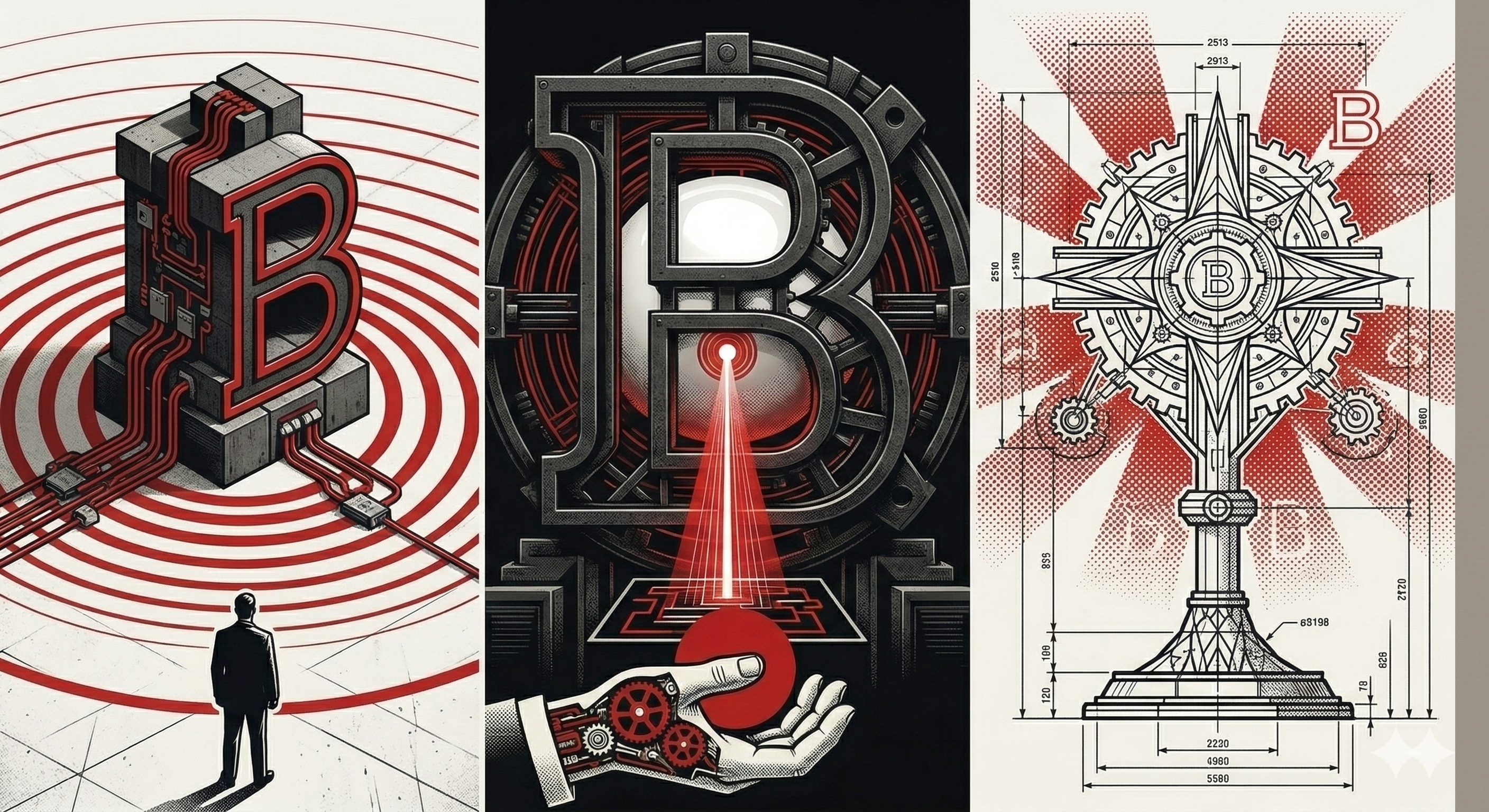
A useful example is the B Generator behind my Plan B identity. The logo is generative. Each iteration of the B is different, drawn from a system that produces variation across colour, texture, and form. But the variation happens within a fixed template. The structure, the proportions, the rules of the system, are locked. What looks like creative freedom is actually creative freedom within a precisely encoded constraint. Schwarzmann coolly uses Fela Kuti's Afrobeat to make the same point. Hours of rehearsal until the groove was completely internalised. Then improvisation within it, not despite it. The output is always surprising. It is never wrong. That is what an encoded brand strategy looks like in practice: not a single approved answer, but a system that makes the right answer the natural one.
2. Coach
Deploy brand logic at the point of idea formation, not after. This means embedding Brand Sentinel thinking into the tools teams already use, coaching users as they clarify and shape ideas, before those ideas arrive at investment gates with momentum behind them. The goal is not to block creativity. It is to make brand-coherent creativity the path of least resistance.
At Fortescue, teams use generative tools to arrive at strategy reviews better prepared than ever before.
The decks look sharper. The narratives are more fluent. But preparation quality and brand coherence are different things. A team can produce a highly persuasive case for something that quietly fragments the brand, and the persuasiveness of the presentation makes it harder, not easier, to catch. The Coach layer is designed to work upstream of both. Present when ideas are forming, not when they are already committed and someone has to be the person who kills them.
3. Gate
Use the encoded model as a pre-production filter. Feed it the work that built the brand and the work you killed. Annotate why. Over time you are not just training outputs. You are training judgement. A living archive of taste that can evaluate proposals against four consistent questions:
- Does this strengthen memory structures?
- Does it amplify a distinctive asset?
- Does it ladder to the defined emotional outcome?
- Would it still make sense if the trend evaporates tomorrow?
If the answer is no, it is noise.
In practice: Too often, strategy and creative teams inside large organisations are tasked with emulating category incumbents. The brief arrives framed as competitive benchmarking. The output is a brand that sounds like a well-researched version of the market leader, which is the most reliable way to ensure you are never mistaken for one. The Gate layer surfaces this pattern before it compounds. It asks not "is this good work?" but "is this our work?"
4. Compound
Measure what holds. Connect outputs to commercial outcomes. Build feedback loops that distinguish signal from noise.
A Brand Sentinel system that is not connected to outcomes is just a more elaborate opinion. The compounding effect, where brand coherence reinforces itself over time, only activates when you close the loop between creative decisions and their downstream consequences. In practice this means tracking not just campaign metrics but distinctiveness over time. Are your assets becoming more recognisable or less? Is your position hardening or softening? Are the decisions being made at the edges of the organisation moving toward your strategic intent or away from it?
Most organisations measure outputs. The Compound layer measures direction.
Synthesis, Not Segmentation
AI gives us the chance to move beyond static personas. The model should understand not just who the audience is, but what they are wrestling with, what they ignore, and what signals credibility in their world.
Behavioural data, search patterns, purchase cadence, content dwell time, real friction points, is the raw material. But synthesis matters more than segmentation. A finely sliced audience model that does not understand motivation produces outputs that are demographically precise and emotionally inert.
Consider the difference between knowing that your audience is 35 to 50 year old sustainability-focused procurement managers, and knowing that they are people who believe they are making the right call but are quietly afraid of being wrong in public. The first gives you targeting. The second gives you a message. When the right layer is encoded, outputs sharpen. When it is not, everything sounds generically enthusiastic.
I wrote about a version of this problem in Your Instincts Are Wrong, which covers what operating in an unfamiliar market teaches you about reading signals rather than meanings. The principle transfers directly. A system that has been given demographic inputs without motivational context is doing the same thing as a brand that has localised its logo colours without understanding the culture. It looks right. It does not land.
Tools as Force Multipliers, Not Toyboxes
Define the tools that are actually useful. Prompt libraries aligned to strategy. Pre-built evaluation frameworks. Content scaffolds tied to distinctive assets. Measurement loops connected to commercial outcomes. Then share them widely.
Do not centralise power. Distribute capability.
The instinct in most organisations is to solve the governance problem by restricting access. Approved tools only. Approved templates only. Approved outputs only. This approach treats the symptom rather than the cause, which is that people do not have a clear enough model of what the brand is and what it is for to make good decisions independently.
Brand Sentinel works in the opposite direction. The goal is not fewer people making brand decisions. It is more people making better ones, because the system they are operating inside has been built to make coherence the default.
The bar has not been lowered. It has been obliterated. The brands that rebuild it inside their systems, at the point of creation, will compound advantage. Those that do not will produce increasingly polished work that says increasingly little.
The relationship between long-term brand investment and AI-era advantage is something I explored in Coke Is Jingling All the Way. Coca-Cola's 137 years of its own advertising gives it a training dataset no challenger brand can replicate. The same logic applies internally. Every decision you encode, every piece of work you annotate, every judgement call you document, becomes a compounding asset.
Three Things That Will Separate the Field
Brand governance moves upstream. The brands that build durable advantage in the next five years will not be those with the best content. They will be the ones that embedded strategic judgement into their creation workflows before it was obvious they needed to. Governance that happens after the work is made will become increasingly ineffective as output volumes grow. The upstream shift is not optional. It is structural.
Presentation quality will stop being a signal. As generative tools raise the floor on execution quality, the gap between a well-presented idea and a well-considered one will widen. Investment committees and brand leaders will need new filters. The question will shift from "does this look right?" to "does this belong here?" Brand Sentinel-style evaluation frameworks will become the answer to that question. Organisations that build those frameworks now will have a meaningful advantage when the rest of the market catches up.
The in-house creative function will be redefined. The most valuable creative leaders in large organisations will not be the best makers. They will be the best encoders. People who can translate brand strategy into systems that others can operate with confidence and coherence. This is closer to architecture than authorship. The architect does not build every room. They design a system that makes every room right. Organisations that recognise this early will build a capability that external agencies cannot replicate, because it lives inside the organisation's own context, history, and accumulated judgement.
Key Principles
For those building or evaluating brand systems in an AI environment, these are the positions this article defends:
- Brand coherence is a systems problem, not a governance problem. Approvals fix symptoms. Encoding fixes causes.
- Model drift is real and cumulative. Vague strategic inputs do not produce average outputs occasionally. They produce average outputs every time, and the gap compounds.
- Presentation quality and strategic coherence are now decoupled. The tools have made it possible to produce persuasive work that is off-brand without anyone in the room noticing until it is too late.
- Emotion without distinctiveness does not build brands. The System1 evidence on this is extensive and consistent. Attention is necessary but not sufficient.
- The Encode layer is the highest-leverage investment most brand teams are not making. Everything downstream of it, coaching, gating, compounding, depends on the quality of what is encoded at the start.
- Distributed capability beats centralised control as a brand governance strategy in high-volume, multi-market, AI-assisted creative environments.
Will your brand be a mood that drifts with the model, or a system that shapes it?