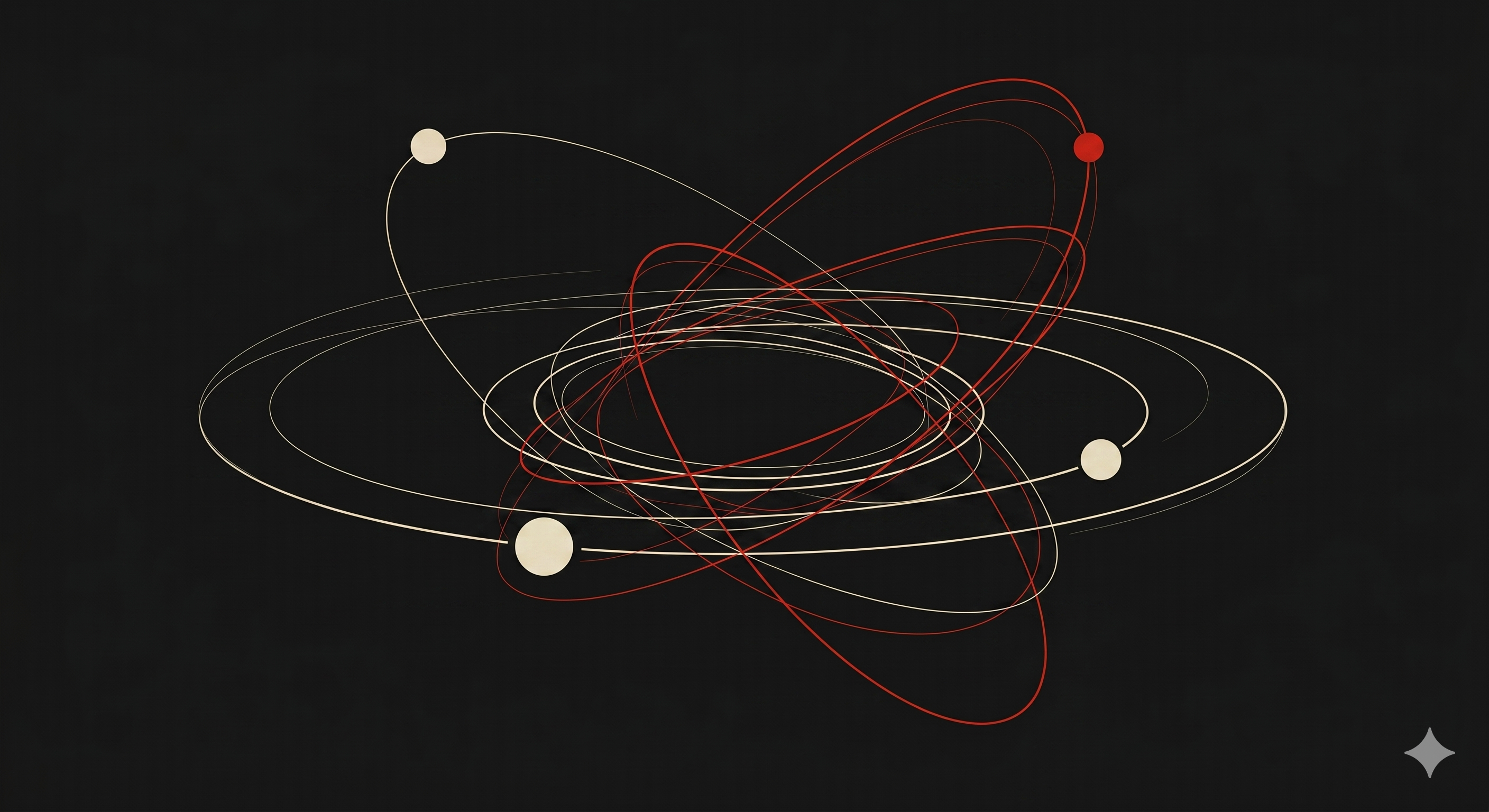
Newton pudo resolver dos cuerpos. Dos masas, gravitación mutua, órbitas elípticas limpias que puedes predecir mil años en el futuro. Añade una tercera masa y las matemáticas colapsan. No existe una solución general de forma cerrada para el problema de los tres cuerpos. El sistema se vuelve caótico, exquisitamente sensible a su punto de partida, estable solo en parches y solo por un tiempo. No puedes resolverlo. Solo puedes modelarlo, simularlo y seguir aplicando fuerza para mantenerlo en órbita.
La estrategia de marca tiene una física similar. La mayoría de los profesionales simplemente nunca pasa de la versión de dos cuerpos.
La versión de dos cuerpos es cómoda. Una marca orbita dos masas: el mercado y el dinero. El mercado es el comprador, el cliente, la persona cuyo comportamiento intentas cambiar. El dinero es el capital, la junta directiva, el inversor, el propietario que pregunta cuánto vale la marca. El buen posicionamiento siempre ha tenido que sostener ambos. Construyes una tesis de alcance que hace creer a un fondo en el tamaño del premio, y un motor de prueba próxima que hace creer a un comprador en el momento de la decisión. Dos audiencias, dos gravedades, una arquitectura que tiene que servir a ambas. Es difícil, y la mayoría de los estrategas se detiene ahí porque ya es lo bastante difícil.
También es incompleta. Porque hay un tercer cuerpo, y tiene más gravedad que cualquiera de los otros dos.
El tercer cuerpo es el equipo interno. Las personas que realmente entregan la marca. El vendedor en la llamada, la gerente de éxito en la renovación, el product manager decidiendo qué se lanza, el agente de soporte absorbiendo una queja un viernes a las nueve. La mayoría del trabajo de marca trata a estas personas como un despliegue. Una asamblea general. Una presentación que se hace bajar en cascada. Una tarjeta plastificada de valores que nadie lee dos veces. Ese enfoque es el error más costoso de la disciplina, porque malinterpreta lo que el equipo realmente es.
El equipo no es una audiencia a la que le transmites. El equipo es el medio a través del cual la marca llega a todos los demás.
Esa es la singularidad que convierte esto en un problema de tres cuerpos y no solo en una lista más larga de partes interesadas. El capital recibe la marca. El mercado recibe la marca. El equipo la transmite. Son audiencia y canal a la vez. Toda marca que alguna vez admiraste fue llevada al mundo por personas que podían decir la frase, la creían de verdad, y la vivieron en diez mil momentos no guionados que ninguna presentación podría anticipar. Y toda marca que murió en la entrega lo hizo porque las personas encargadas de llevarla no pudieron, o no quisieron.
Por eso el sistema se vuelve caótico en el momento en que los añades. Tres gravedades en competencia, ninguna reducible a las otras. Una frase que emociona a la junta puede sonar hueca para un comprador. Una frase que convierte a un comprador puede ser impronunciable para un vendedor, demasiado ingeniosa, demasiado ajena, demasiado lejos de cómo realmente habla. Una frase que el equipo ama puede ser invisible para el capital, verdadera en el terreno pero ilegible en la sala de juntas. Optimiza para una y las otras dos se desvían. No hay solución de forma cerrada. Solo está el trabajo de mantener tres órbitas en tensión a la vez.
La física ofrece una sola misericordia. En un sistema de tres cuerpos existen los puntos de Lagrange, posiciones estrechas donde las fuerzas en competencia se equilibran y un cuerpo pequeño puede permanecer en equilibrio relativo. Son escasos y precisos. Pero existen.
Una frase de posicionamiento es una búsqueda de un punto de Lagrange. La frase escasa que sostiene a los tres cuerpos a la vez. El capital escucha crecimiento y escala. El comprador escucha respeto por lo que realmente hace. El equipo escucha algo lo bastante verdadero como para repetirlo sin titubear. Cuando llegamos a "more of your teaching" para un negocio educativo, la prueba nunca fue si a la junta le gustaba. La junta era el cuerpo fácil. La prueba era si un vendedor podía abrir con esa frase y una profesora podía escucharla sin erizarse, y si ambas cosas seguían siendo ciertas mientras un fondo seguía viendo debajo un premio del tamaño de una categoría. Eso es un punto de Lagrange o no es nada.
Eso replantea el trabajo. La tarea del estratega no es resolver el sistema, porque el sistema no tiene solución. Es encontrar una órbita estable y luego mantenerla estable. La presentación que entregas es una fotografía de un sistema en movimiento, precisa por el instante en que se abrió el obturador y desviándose en el momento en que se cierra. El tercer cuerpo siempre se está moviendo. La gente se va, llega gente nueva, la frase se recuerda mal, la gravedad del día arrastra a todos fuera de curso. Sin fuerza continua, la órbita decae.
Ese es el verdadero argumento para tratar la marca como un sistema vivo en lugar de un artefacto entregado. No porque suene moderno, sino porque el problema de los tres cuerpos lo exige. No puedes resolver el caos una vez y marcharte. Codificas la posición, entrenas a las personas que la llevan, filtras lo que sale contra ella, y compones la cosa a lo largo del tiempo. Aplica fuerza, o mira cómo colapsa la órbita.
La mayoría de la estrategia de marca todavía está resolviendo el problema de los dos cuerpos con gran confianza, preguntándose por qué la respuesta sigue desmoronándose en el terreno. La respuesta se desmorona porque siempre hubo un tercer cuerpo. Era el que hacía todo el trabajo.