Write me a short essay on XXXX.
Paste that into any frontier model, swap the XXXX for a topic, and wait about eight seconds. It will hand you back a plausible-sounding argument built from an average of everything ever written on the subject. The prose will be competent. The structure will hold. The references, mostly, will be real. It will be, on inspection, both fluent and forgettable.
This is the new ground floor. Everyone walking gets to this point. Industry titans have spent two years congratulating themselves in public for reaching it.
The question isn't what the machines can do. It's what they can't. The honest answer is that they still can't choose. Not in the way a human writer chooses.
A model retrieves. A model recombines. Given a corpus (a warehouse full of books,) it will find the next most likely token and place it after the last. It's very good at this, and getting better. What it isn't doing is choosing what matters.
Writing is choosing. You walk through a life accumulating context. Parts are deliberate: a book you sought out and passed on, a city you moved to because it felt important. Most are threads of fate: the train delay that put you in the wrong carriage next to the person who taught you a thing they didn't know they were teaching, the chapter of a book you skimmed at seventeen that surfaces at forty-three, exactly when you need it.
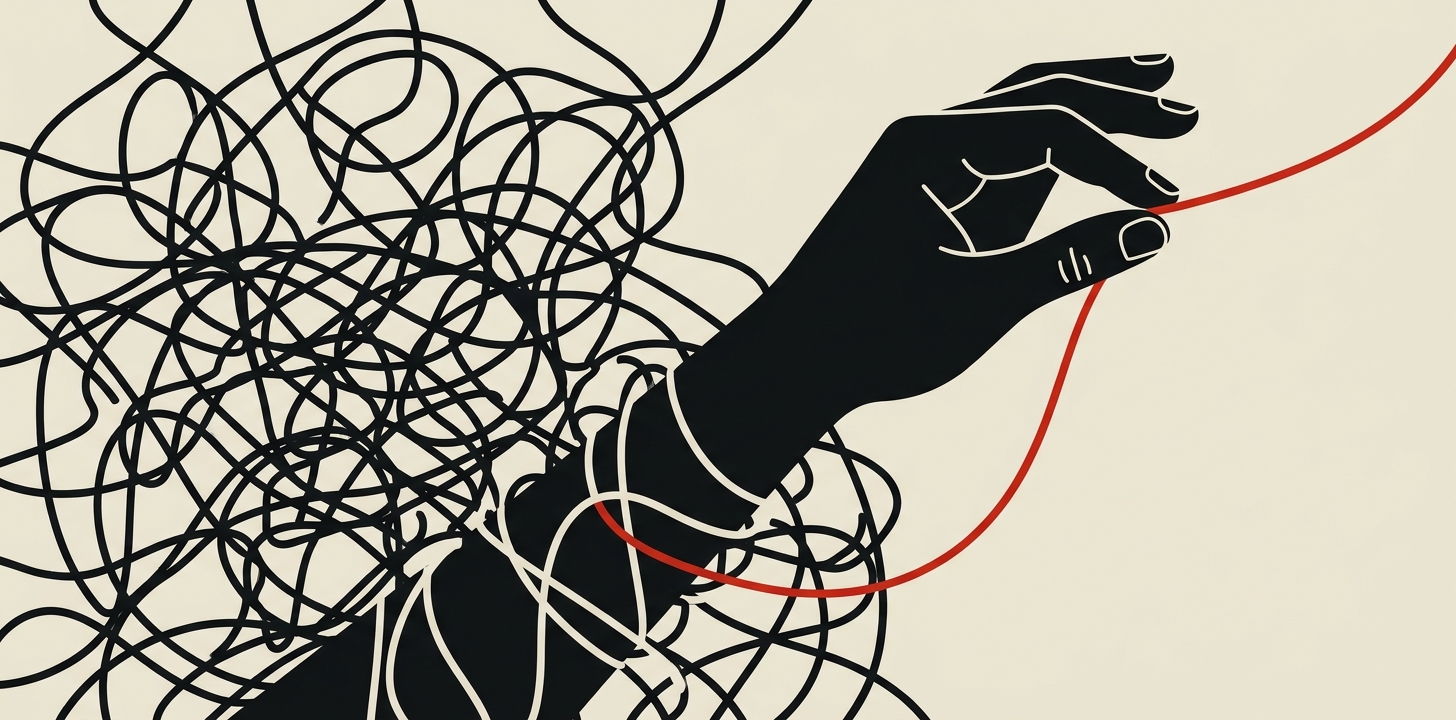
Out of that unstructured pile, you choose. You notice one thing rather than another. You pull a thread from a memory nobody else has. You put two ideas next to each other that have never been in a room together before. And then you sew.
That is what a writer does. Curation before composition. Consideration before writing. The story is the artefact left behind when a mind chooses what to notice from the context it has been shaped by.
Machines don't have this problem. They have the whole corpus, all at once, weighted by statistical presence. The novel choices a good writer makes by chance and taste are, for a model, unreachable, because the model is optimising for the most probable next word, not the most surprising or the most true. The surprising and the true are lower-probability than the average. That's why they land.
Which means the machines have upended the retrieval and recombination end of writing. They haven't touched the curation end, and they aren't structurally set up to.
If you write for a living, or think for one, this is the part of your job that survives. Not the fluent prose. Not the well-formed argument. The choosing. The taste (many are calling it that). The specific attention you paid to specific things that no one else was paying attention to at the time. The willingness to notice one detail among ten thousand and argue it forward against the average.
The community you learned inside is still talking through you. Your task is to decide what it says next. That decision is the whole of your contribution and, as far as anyone can show, the whole of what still costs a machine more than it's worth.
The lobby is overrun. We need to climb some stairs.
Part three of a short series on inherited ideas. Piece one on the biface here. Piece two on the tool that reads your writing here. Plan B helps businesses turn taste into structure. Get in touch.