The agent has a face now
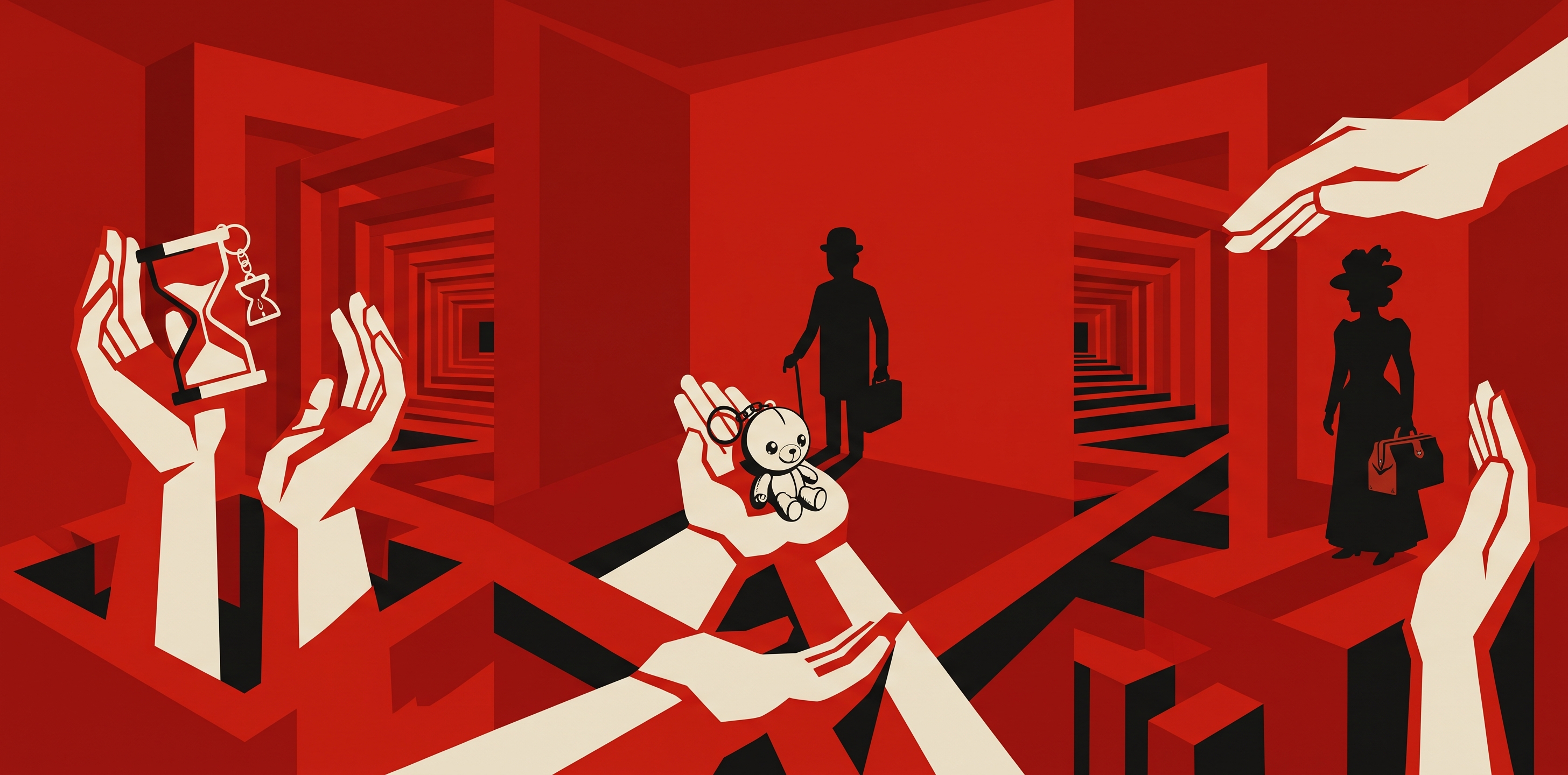
Last week Mark Zuckerberg held up a keychain with a face on it. The character is called Jolly. It has a two-inch screen, a fingerprint sensor, and is meant to book your train, answer your email, and buy the thing you mentioned in passing. It looks like a Labubu, deliberately. Big head, big eyes, small nose, plush limbs. Kindchenschema, Konrad Lorenz's word for the evolved reflex that pulls caregiving out of adults. Meta has dressed an intermediary in a costume you protect. It ships in December. Meta will take a cut of whatever it buys.
Zoe Scaman marked the occasion by republishing a talk she gave last November, in which a woman called Jenny wakes up in 2027 and her agent has already bought her a belt. The talk is good and well worth the read. The argument is that brand and customer will soon meet only through a machine, and that the machine reads data rather than ads.
Her argument assumes we transition to the new tool as a whole system, at launch. That has never once been how it went.
Media never dies. Behaviours move house
Television was going to kill radio. It took evening drama and the family in the front room, and left radio the car, the morning, and music. Radio has remained profitable ever since. Streaming was going to kill television. It took scripted drama and left live sport and the news. The internet was going to kill print. It took the classifieds, which were the profit, and left the readers, who were not.
AI is going to kill everything. History says it won't.
The shift lands more slowly than everyone expects. Newspapers spent twenty years proving the doomsayers wrong and then proved them right in five.
The behaviour is comparison
Which behaviour is the agent taking? The first wave stalled. The retreat tells you where the line is.
OpenAI switched on Instant Checkout inside ChatGPT in September 2025. On 24 March 2026 it changed course. Retailers like Walmart now run discovery inside ChatGPT and send the shopper back to their own checkout, with account linking and loyalty intact. Walmart listed around 200,000 products through Instant Checkout from November. Daniel Danker, their product chief, told Wired in March that purchases completed inside ChatGPT converted at a third of the rate of sending the same people to Walmart.com. He called the experience unsatisfying. People let the machine find the thing. When it came to paying, they wanted a logo they knew.
An IBM and NRF survey of 18,000 consumers across 23 countries in the third quarter of 2025 found 45 per cent already turn to AI somewhere in the buying journey: 41 per cent to research products, 33 per cent to interpret reviews, and 31 per cent to hunt deals. That is a lot of people delegating the same step. The twelve tabs and the spec sheets. The tedious middle of a purchase that nobody enjoys.
That is the front room after dinner. Comparison is the behaviour that moves. Deciding what you want stays with the human, and so, for now, does paying. Jenny's belt scenario assumes all three go at once, at launch, and the market has just spent six months saying no.
The shelf becomes the corpus
If the machine takes comparison, the fear is that brand stops mattering, because a machine comparing on price, fit, and delivery window has no use for a memory structure. The early research says the opposite, with a twist.
A June 2026 study of skincare brands across three commercial models found a conditional monopoly. Given identical specifications, the well-known brand was recommended every time. The monopoly collapsed with a rating advantage of less than a tenth of a star for the challenger. The prior is total, and fragile.
A September 2026 study across six models complicated the picture. Category-only prompts frequently omitted large, established brands altogether, and the popularity bias familiar from old recommender systems was weak. In drills and hiking jackets the models leaned premium and neglected the mass market. The strongest predictor of being recommended was Google search interest, then online brand conversation. Advertising spend, news mentions, and Wikipedia traffic added almost nothing once the others were counted. Both are preprints, run in fresh sessions with no purchase history. They measure the model's prior, not the recommendation you would receive if the model knew who you were.
The PR industry has read this differently. Muck Rack's Generative Pulse study, running since July 2025 and corroborated by others, finds that around 85 per cent of citations in AI answers come from earned media. The trade press has taken that as news coverage becoming the raw material of the machine's answer. That conflates two things. Being cited as a source is not the same as being chosen as the answer. The September study measured the second and found the first was not driving it. Press mentions add almost nothing once search interest and online conversation are counted.
Read together: salience survives, but the substrate has changed. The shelf had a physical limit on how many facings a leader could hold. A corpus has none, so the brand people are talking about now can hold the whole thing. And the brand people bought last year but stopped discussing holds nothing. What the machine reads is discourse, not footprint. That is a narrower and more current form of mental availability than the one most boards have been paying for.
Medium or middleman
There is one place the media analogy stops working, and it is the place that matters.
Media survive. Middlemen do not. The Yellow Pages, the travel agent, the record shop, the branch on the high street. When a new tool absorbs an intermediary's function, the intermediary disappears. Nobody waited a generation to stop ringing directory assistance.
Agents are not a channel. They are an intermediary. The question for anyone in the chain between a product and a buyer is not whether AI is coming but which of the two things you are. Brand is a memory structure, a set of associations carried in the heads of the people who might buy. It behaves like a medium. It moved from the town crier to the poster to the wireless to the screen and kept its job every time. The retailer's role in the consideration set, the comparison site, the affiliate, the agency's media planning function. Middlemen, every one. Each does the job the agent has just taken.
That is why the belt scenario frightens the wrong people. The brand still gets remembered. It gets remembered by a machine that reads what is written down rather than what was felt, which is a change of discipline, not a loss of role. The people who should be frightened are the ones whose job was manning the tedious middle.
What a board should do with this
Three things, none of them a transition plan.
First, stop asking whether the company is ready for agents and ask which behaviour the agent will take from your customer, and whether you were the one doing it. If the answer is comparison, and you are a retailer or a marketplace, you are the middleman in the story. If you make the thing, you are the medium, and your problem is legibility.
Second, treat legibility as a discipline rather than a project. The machine reads what is written down, current, and structured. The research above says legibility now beats awareness, and current beats accumulated. That is a different kind of maintenance from the one marketing departments were built to do. It looks more like investor relations than advertising, which is not a coincidence.
Third, notice that nobody has run the study that would settle any of this. The two papers above measured a model's prior in a fresh session. The number that matters is recommendation share against actual brand size, with an agent that has memory, joined to purchase. For now it feels like it is worth something. The platforms hold that data and have no reason to publish it. The brand panels hold the other half. Whoever puts the two together first owns the only defensible figure for what a brand is worth to a machine.
Until then, the safest reading of history is the boring one. The new tool takes a behaviour, not a world. The last people to work that out are usually the ones selling the tool.
Plan B works on brand as a memory structure machines can read. If you are the medium and not the middleman, and your legibility discipline is thinner than your advertising one, get in touch.